Showing posts with label Apostolic. Show all posts

Monday, February 11, 2013

Pope Benedict XVI Resigns: What Does It Mean?

I could not quite believe my eyes this morning when a New York Times alert flashed across my phone: "Pope Benedict Resigns." This is probably the biggest single news item in the worldwide Christian Church in my lifetime. The spiritual leader of 1.2 billion of my brothers and sisters in the Roman Catholic community is doing something that has no real precedent. While it is true that there was a pope who resigned back in 1415, that resignation came amidst one of the greatest scandals in Church history, with three different popes vying for control!

This resignation is clearly different. Though Benedict has certainly been a controversial pope, presiding over an increasingly firm turn to the theological right, he has not been personally embroiled in scandal to the same degree. Certainly nothing that would indicate that he should resign from an office that until now has essentially been considered unresignable.

And yet, here we are. Benedict has announced his retirement from the papacy on the basis of his advanced age and his own personal judgment that he is no longer able to fulfill the role of spiritual father to the Roman Catholic community. Declaring his retirement date as 28 February, 2013, Benedict is giving a little more than two weeks notice. Assemble the cardinals: It is time to select a new pope!
I am sure that there will be a great variety of reactions to Benedict’s resignation. Some – especially among the Roman Catholic community’s progressive wing – will cheer. Some will be appalled, and many others will be confused. I understand all of these reactions, but I have a different one. I feel awed and grateful.
In this unexpected act, I feel like I am catching a glimpse – perhaps for the first time – into the real character of this pope. This is a spiritual leader who has the humility to set aside his official authority and admit that he no longer has the strength or the divine calling to serve as the apostolic guardian of more than a billion souls. That takes some guts!
I cannot see into Benedict’s heart, and I am in no position to judge him. Nevertheless, I must say that I am deeply impressed by this act. It inspires me to be more willing to reevaluate my own spiritual gifts and sense of divine calling. Benedict’s resignation reminds me that I must be open to laying aside even the most importantwork that I do in order to be faithful to the One who calls me. By laying down the splendor, power and authority of the papacy, Benedict challenges me to follow his example, releasing my own privileges and reputation in order to become a more faithful, loving servant to the whole body of Christ.
In this one decision, Benedict reveals himself to be truly apostolic. As he lays down all his worldly crowns and honors at the feet of Jesus, he can say with integrity, “Be imitators of me, as I am of Christ.“-
For another Quaker’s reaction to Benedict’s announcement, check out Dan Randazzo’s blog, A Closeted Radical.

Thursday, November 29, 2012

Should Quakers Be Laying On Hands?

Now when the apostles at Jerusalem heard that Samaria had accepted the word of God, they sent Peter and John to them. The two went down and prayed for them that they might receive the Holy Spirit (for as yet the Spirit had not come upon any of them; they had only been baptized in the name of the Lord Jesus). Then Peter and John laid their hands on them, and they received the Holy Spirit. - Acts 8:14-17

Have you received the Holy Spirit?

The Book of Acts describes how the first disciples in Jerusalem experienced the coming of the Spirit, and this outpouring quickly spread to thousands of others. It was not long before the Church in Jerusalem was scattered by persecution, but this just spread the gospel message more widely.

One of these scattered disciples, Philip, shared the good news in Samaria. The Samaritans were the red-headed stepchildren of the Jewish family. They were outsiders par excellence, widely considered untouchable heretics by their Jewish neighbors. Yet, perhaps because of their shunned status, Samaritans were eager to embrace the news about Jesus. They heard the message and accepted it.

The new believers in Samaria took the first step, being baptized with water as a symbol of their whole-hearted embrace of the message that Philip had shared with them. But there was still something missing. The leaders of the Church in Jerusalem knew in their bones that the people of Samaria needed more than human belief in the message about Jesus: They needed to experience Jesus for themselves. They needed to taste his very Spirit.

What does that even mean? Why weren't the apostles satisfied with the fact that the Samaritans had become "orthodox Christians"? What compelled some of the apostles in Jerusalem to venture out to Samaria and lay their hands on the new believers? And why did the Holy Spirit wait for the apostles' touch before indwelling the new church? If the Spirit blows where it will, what need is there of human intervention?

There is a reason that our spiritual ancestors used such rich, diverse language to describe the Spirit: A dove descending from the sky, rushing wind, tongues of fire, living water, the sound of silence. All of these words offer a window into the mystery of the Holy Spirit, the source of a Life and Power so magnificent that our faith is incomplete until we receive it.

It is my experience that the Spirit is beautifully mysterious and unpredictable. Any attempt to pin her down and force her to obey human regulations will fail. And yet, this story of human involvement in the work of the Holy Spirit rings true to me. It fits with my own experience of receiving the Holy Spirit into my life.

When I first became a Quaker in 2004, I did so because I was convinced at a very deep level, far beyond simple intellectual assent, that the testimonies of Friends were true. I could sense that there was a ground of truth that was solid and immovable. I sensed that God was real, and that my life needed to conform to that Truth. Yet, there was something missing. While I had begun to accept Friends principles and could sense God's hidden presence, I did not experience God as an actor in my life. In reality, I was still in the driver's seat. I was "exploring God," like the famous old blind men who could each feel a different part of the elephant.

But when the Holy Spirit came on me, it was as if that elephant reached out and grabbed me with her trunk! No longer was God an object of my personal study; I came face-to-face with a divine Presence and Personality that had plans for me, and who would guide me if I opened myself. I was shown, in a deeply personal way that can never be fully explained, that God is not an "it," but rather a "thou."

And how did I come to have this experience? What was the catalyst for this encounter with the divine Thou? While for me there was not a literal laying on of hands, the circumstances surrounding my reception of the Holy Spirit bore great similarities to the experience of the Samaritan church.

I was at the World Gathering of Young Friends, in Lancaster, England, together with hundreds of other young Quakers from around the world. During the gathering, we heard sermons from a variety of ministers. One of these, a fiery preacher from Philadelphia, challenged us to know who we were and to accept the mantle of prophecy that the Spirit was calling us into. Early on in her sermon she warned us, "you didn't ask me, but I'm about to give you a double portion of what I have." At one point - referencing the words of Jesus in John 15 - the minister exclaimed, "you're cleansed!" She spontaneously grabbed a container of water that was sitting up at the podium and began sprinkling those of us sitting closer to the front.

The sermon was riveting. It was the most explosive, powerful vocal ministry I had ever encountered. She spoke directly to our condition that evening, and the Spirit was palpably present in the room - though I was not consciously aware of it at the time.

It was later in the evening that it happened. I was sitting on a bench with another young Quaker, and we spontaneously fell into silent worship together. Suddenly, the Holy Spirit was upon us, bathing us with wave upon wave of light, power, love and tender mercy. There simply are no words. But every true word I have spoken since that night has flowed from this Source.

I am convinced that the presence of apostolic authority and blessing that night were instrumental in the work of the Holy Spirit. The faithfulness of this minister from Philadelphia played the same role for me as Peter and John did for the new believers in Samaria. It is enough to make me wonder whether we Quakers should put more emphasis on the importance of human participation in the gift of the Holy Spirit.

Has this happened to you? Has someone laid hands on you - literally or figuratively? Have you received a blessing from another person that has allowed you to plunge far deeper into relationship with God than you ever had before? What do you think the role of human agency is in the ministry of the Holy Spirit? Could it be that we Quakers need to be more open to sharing the gift of the Spirit by the laying on of hands?

Monday, June 04, 2012

The Seed That Dies - Great Plains Yearly Meeting 2012

Very truly I tell you, unless a kernel of wheat falls to the ground and dies, it remains only a single seed. But if it dies, it produces many seeds. Anyone who loves their life will lose it, while anyone who hates their life in this world will keep it for eternal life. - John 12:24-25

Great Plains Yearly Meeting has been thinking about dying for a long time. Back in 2001, Great Plains - a fellowship of Quakers in Nebraska, Kansas and Oklahoma - had dwindled to only five local congregations, and Friends considered seriously whether GPYM's time was up. Yet, for some reason - whether a nudge from the Spirit or the lure of nostalgia (perhaps a bit of both) - Friends re-committed themselves to existence as a Yearly Meeting.

Over the nine years that I have attended GPYM, I have watched Friends wrestle with what continued existence would mean. Is GPYM primarily a family reunion - an assembly of "good people" who like one another? Does the Yearly Meeting primarily exist as a connection with Quaker institutions on the East Coast? Does GPYM have something unique to say to its own context in the American heartland? Could the Yearly Meeting be a base community for a shared life of radical discipleship and loving action for liberation and justice in the Great Plains region?

During my time attending Great Plains, it has seemed like the default mode for GPYM is to operate as a place of comfort, security and self-affirmation. The Yearly Meeting provides a sense of identity and connection with the wider Quaker world, a touchstone in a region with few Friends of like mind. Often, the posture of folks in Great Plains Yearly Meeting has been fatalistic - resigned to the sleepy decline of our Christian fellowship.

But we were not left without a witness. Over time, I have seen God prodding Friends to choose a path of renewed life and vitality as Christ's Church. God has raised up a number of prophetic ministers who have called the Yearly Meeting to a deeper engagement with our shared experience of Jesus Christ, and his call to be salt and light in the world. These prophets have not always been well-received, but their ministry has had a clear effect over the long haul.

This year, the clerk of the Yearly Meeting brought a proposal that she be financially released (Quakerese for "hired") for part-time service to the Yearly Meeting. She explained that she felt called to dedicate a substantial portion of her time to nurturing Meetings throughout the region and helping to spur the development of new leadership that could help to sustain the work of the Yearly Meeting in the years ahead.

In 2009, after a season of traveling ministry among Friends in the Great Plains region, I had laid a similar concern before Great Plains Yearly Meeting. At that time, however, Friends were not ready to provide support for such an out-of-the-box proposal. GPYM's Ministry and Counsel minuted, "Our Yearly Meeting simply is not yet at a place where we can corporately affirm an apostolic ministry" (M&C 09-17). Three years later, however, the ground seems to have been cleared enough that Friends are seriously considering supporting just such an apostolic call.

Jesus teaches us that the way to everlasting life is through apparent death, and that by clinging to what we already have, we deny ourselves the riches that are to come. Have we reached a place where we are ready to die to our comfort and nostalgia - to bury that which once was so that we can reap that which God is bringing into being? What does it look like for the Church to die to itself, and to be raised again, clothed in Jesus Christ? Are we willing to let go of the dirty rags that we cling to in order to put on the fine linen of Christ's wedding banquet? Can we embrace the self-death that leads to overflowing life in the Spirit?

So will it be with the resurrection of the dead. The body that is sown is perishable, it is raised imperishable; it is sown in dishonor, it is raised in glory; it is sown in weakness, it is raised in power; it is sown a natural body, it is raised a spiritual body. ... - 1 Corinthians 15:42-44

Tuesday, May 22, 2012

All Things To All People

To the Jews I became as a Jew, in order to win Jews. To those under the law I became as one under the law (though I myself am not under the law) so that I might win those under the law. To those outside the law I became as one outside the law (though I am not free from God's law but am under Christ's law) so that I might win those outside the law. To the weak I became weak, so that I might win the weak. I have become all things to all people, that I might by all means save some. - 1 Corinthians 9:21-22

The ancient society where Christianity emerged consisted of a wide variety of local cultures, all united under Roman rule. Greeks and Jews mingled, and the cities of the Empire allowed a cosmopolitanism that had rarely existed before in Western history. The early followers of Jesus were challenged to share the gospel message in a context where all truth was relativized under the coercive power of the Roman state. In that society, people could worship whatever gods they chose - so long as they also worshiped Caesar.

I also live in a society where people worship a variety of "gods" and participate in many subcultures and lifestyles. Yet, just as was the case in ancient Rome, the modern-day empire I live in is held together by a set of common assumptions. Although no one is required to literally worship the State or its rulers, this society is held together by the veneration of wealth and the exercise of political power. All of us, from smallest to greatest, are caught up in an economic and political system that demands our allegiance just as surely as Caesar ever did.


The God whom I worship, and the gospel that I proclaim, stands in stark contrast to the worship of wealth and human power that lies at the center of American society. The "upside down Kingdom" of Jesus reveals the weakest to be the strongest and that those who put themselves first may find themselves left out. The good news of Jesus represents a direct challenge to the core assumptions of this present age.

This is scary stuff. It is not accident that the rulers and authorities of ancient Rome brutally tortured and executed Jesus, and continued to persecute Jesus' followers for centuries. When we directly confront the foundations of Empire, we should expect a response that is in keeping with Empire's way of doing business.

Despite all of the persecution, torture and summary executions that the early Christians faced, the early Church did not condemn the whole of Greco-Roman society. On the contrary, the early Christian community made great efforts to communicate the good news in terms that would speak clearly to the wide variety of cultures and experiences that made up the ancient world. Rather than insisting that everyone become a Jew, the disciples proclaimed a new way that was open to all people, regardless of their ethnic or cultural affiliation.

As Paul explained in his letter to the Ephesians, the mission of the early Church was to proclaim a gospel that reconciled women and men from all sorts of backgrounds, whether Jew or Greek, uniting them into one new humanity. This new spiritual community did not have the effect of eliminating cultural differences; on the contrary, the cultural diversity of the ancient world remained, but it was placed on a new foundation. Rather than worshiping the wealth and power of Caesar, all the nations of the earth would now join in worshiping the one true God!

How can I share the good news in ways that affirm the diversity of culture, language, identity and experience that I encounter in my city? How can I lift up that which is good in my cosmopolitan society, while at the same time challenging the harmful foundation of greed and pride that has taken us captive? How can I model and preach a gospel that, rather than eliminating our differences, places all of us on a new foundation in Jesus?

Friday, April 08, 2011

A Burning Fire

In the first generation of the Quaker movement, news of the gospel spread across Britain from house to house, city to city. Quickly, the message was taken abroad to the continent of Europe and to the British colonies in the Americas. These early years of Quakerism were characterized by an untamed passion for sharing the good news, inviting others into spiritual communion with Christ and with each other.

This good news spread largely outside of official channels. While Margaret Fell provided practical aid and a communications hub at Swarthmoor Hall, there were not initially formal structures for organizing the wave of evangelism that proceeded from the north of England. The Religious Society of Friends began as an organic movement of the apostolic faith. The Lord called women and men to ministry, and they responded with obedience. Christ used these 17th-century apostles to preach the word and gather his people Friends Meetinghouse and Graveyardtogether. Everywhere the traveling evangelists went, the Holy Spirit raised up local leaders and established new communities.

Within decades, this burst of pentecostal fervor had established an organic network of Meetings across Britain and the American colonies. Yet, just as this movement reached the peak of its intensity in the early 1660s, severe persecution came. Friends organized themselves in increasingly centralized bodies - Yearly Meetings - as a way to coordinate their response to nationwide persecution, especially in England.

The persecution eventually passed, but Friends' new emphasis on centralized structures remained. Over time, passionate, evangelical faith diminished and institutional centralization increased, accompanied by an increasing reliance on procedure as a source of authority. Eventually, many Friends would come to believe that it was procedure that defined them. Orthopraxy and institutional authority increasingly usurped the unpredictable guidance of the Holy Spirit.

Today, Friends are steeped in the institutional apparatus of former generations. We appoint members to committees and boards. We govern non-profit organizations. We manage historical sites. WeQuaker Graveyard are generally nice, respectable, civic-minded people. But where is the spiritual power?

What happened to the fire that drove early Friends to cross oceans? What became of the radical faith that led women and men to face death, torture and imprisonment? How often are we imprisoned for the gospel today? How many of our Meetings actively support the spread of the good news that Jesus Christ is here to teach us himself? We are often so busy maintaining the institutional legacy of our ancestors that we spend more time keeping up buildings than we do sharing the good news of Jesus with our neighbors.

But that does not have to be the end of the story. Just like the early Friends, we have an opportunity to challenge the status quo and live into the fantastic life and love that Jesus reveals in our hearts and in our life as a community. It is important to remember that those early Quakers we admire so much got into a lot of trouble. They upset people and caused division in their communities. They were not popular among respectable people.

Are we today ready to take the same kinds of risks for Truth that our spiritual ancestors did? How can we support one another in breaking out of business as usual and re-discover the mission that Jesus has for us? What does radical discipleship look like in 21st-century America?

Friday, January 21, 2011

Being Publishers of Truth

"Let all nations hear the sound by word or writing. Spare no place, spare no tongue, nor pen; but be obedient to the Lord God: go through the work; be valiant for the truth upon earth..." - George Fox

The early Quakers were serious about preaching the gospel. In the first decades of the Friends movement, the message that "Christ is
George Fox refuses to take an oath come to teach his people himself" was carried out from the Quaker strongholds in northern England to other parts of the British Isles, America, various kingdoms on the continent of Europe, and even into the Muslim world. Young men and women emerged from the fields and towns where they had grown up and, compelled by Christ's call in their hearts, journeyed to distant lands whose languages they did not know.

Wherever they went, the early Quaker missionaries announced the arrival of the King of kings, who overthrew all earthly pretenders toFriends minister Mary Dyer being led to execution in Boston the Throne. They called attention to the Lord's living presence through prophetic signs - such as burning their musical instruments, walking naked in the streets, and heaping burning coals on top of their heads. They preached the good news wherever they could find an audience - whether in the open air, in a crowded bar, or in a government-run church building where they faced beatings and imprisonment for interrupting the state-sanctioned preacher.

One of the most powerful ways in which the early evangelists bore witness to Christ's resurrection presence was through the use of pamphlets. During the Early Quaker publicationturbulent years following Parliament's execution of King Charles I, England was awash in written propaganda from a variety of religious and political perspectives. Print media was new then, and the early Friends took advantage of it to spread the word of God-with-us.

Today, we as Friends in the English-speaking world are, in many ways, experiencing a drastically different context from the Valiant Sixty. We are not, at the moment, living in the kind of intense societal upheaval that characterized the first decades of the Friends movement; and we are not, in general, facing any real persecution for our faith. Perhaps relatedly, we are not - as a general rule - particularly committed to personal evangelism, publicly sharing our faith with the wider culture, or taking risky, prophetic action to witness to the love of Jesus Christ that we have experienced.

How might we today be called to, as Fox put it, "let all nations hear the [gospel] by word or writing"? What might it mean to share theWoman preaches in Quaker meeting good news of Christ's literal, teaching presence, both within our own culture, and in the wider world? The Quaker community today is overwhelmingly concentrated in areas of historical British influence - Kenya, the United States, the United Kingdom, Canada, Australia and New Zealand - with Central and South America being the only places where there are significant concentrations of Friends without an historic connection to the British Empire. Why have we as Friends failed to reach beyond the English cultural sphere?

Is the good news that Jesus can be personally known, loved and obeyed unique to British colonial cultures? God forbid! Our faith as Friends is rooted in the belief that Christ's presence and power is universal, transcending all national, linguistic and cultural boundaries. How, then, can we demonstrate the practical truth of our faith? How can we share this good, universal news of immediate relationship with Christ, both as individuals and as communities?

As different as our circumstances may be from that of the early Friends, we do have at least one thing in common: We are living in an age of new communications technology.Barclay's Apology in French Just as the printing press was a revolutionary breakthrough in the seventeenth century, we are experiencing a similarly game-changing technological shift in the twenty-first. How is God calling us to use the internet, and other forms of electronic communication, to advance the gospel in our day?

There are signs that some Friends are experimenting with these new media. QuakerQuaker.org is an example of creative use of the online blogging community to draw together Friends and seekers to exchange ideas and develop relationships that can serve the Lord. Another recent, if still embryonic initiative is QuakerMaps.com - which, if further developed and cared for, could serve as a modest platform for outreach to non-Quaker seekers, as well as existing Friends. There are other sites that provide information about the Quaker faith, such as QuakerInfo.org, QuakerInfo.com, and Quaker.org. All of these sites are useful and have the potential to reach many Friends and seekers in the English-speaking world. But what about the other 95% of the world's people?

There are some signs of hope. For example, Spanish Quaker Luís Pizarro recently began publishing a blog, Cuaquero.org, that is intended to share the gospel message with the people of Spain. Yet, there is still so much that remains to be done. What if we placed an emphasis on training ourselves to be ambassadors to other cultures, learning another language and familiarizing ourselves with another culture? What if we made it a priority to share the gospel message online in every major language, providing resources for learning about Friends' beliefs, practice, and how to set up a new worship group? Surely Friends already have the capacity to do this sort of outreach in dozens of languages. Are we ready to take the time and effort to live into Christ's call to preach the good news to all people? Do we still believe that we have received a message worth sharing?

Tuesday, November 09, 2010

Missional Quaker Faith: Organic Growth

We read in the Book of Acts that, in the days and weeks following the coming of the Holy Spirit among the disciples, a tiny, rag-tag, mostly clueless band of disciples grew into a movement that was felt all across Jerusalem. People were being healed, lives were being changed, and a new community was taking shape where everything they owned was dedicated to the mission of glorifying God and proclaiming Jesus Christ. "And day by day, the Lord added to their number those who were being saved."(1)

Since those early days, we have seen this pattern replayed again and again wherever women and men have received the Holy SpiritOn a bus to the World Gathering of Young Friends, 2005 and lived into God's call for their time and place. The early Quaker movement is a prime example. Signs of spiritual power were common; the Holy Spirit was felt and obeyed by the community as a whole; and the growth in numbers and in spiritual maturity of the Religious Society of Friends was meteoric. Within a matter of decades, Friends transformed the religious landscape of the English-speaking world.

There have been many other movements that have exhibited the vigor and charisma of the early Church, including the Wesleyan and Pentecostal movements. And we can expect to see more such movements of the Holy Spirit in the future, because Christ is ready to lead all who will open their hearts to him and live into the Kingdom-life. He stands at the door and knocks.(2)

When we let Christ lead us directly, we see the reemergence of the apostolic Church. We witness remarkablePeople in the streets in Richmond, Indiana energy and dynamism when all of the gifts of the Spirit find expression in the community of faith; and the full exercise and expression of the gift of apostleship is instrumental in creating an environment where all the other gifts can flourish.(3)

Each of the gift-clusters represented by the traditional offices of the Quaker Meeting have an important role to play in grounding our communities in the Life of Christ. The prophetic gospel minister calls us to repentance and new depths of openness before God; the elder nurtures our spiritual life, encouraging us when we are discouraged and correcting us when we miss the mark; and the overseer cares for our needs and helps us to resolve conflict. Yet, without fully embracing the gift of apostleship, this sturdy triad can devolve into a self-serving institution that cares for itself more than it does for the mission that we are called to in Christ.

However, when we receive and empower the gift of apostleship that the Spirit provides to our communities, we unleash God's intentionYoung Adult Quakers at Beacon Hill Conference Center for us as the Church. Where before we were self-focused, God gives us a heart for serving others. Where we were comfortable, God creates in us a discomfort that can only be relieved by justice and righteous living. Where before we isolated ourselves from those around us, God calls us to reach out.

When we have embraced the apostolic gift that God sends among us, we are transformed as a community, because we realize that our community exists for God's mission, not the other way around. Alan Hirsch observes that a disciple-community living into its apostolic gifting has four traits:

  • It has the ethos of a movement, rather than an institution
  • It spreads like a virus, via an "incarnational" model rather than an "attractional" model
  • It forms new communities that are reproducing and reproducible
  • As it grows, it takes on the structure of a network of communities (4)


A Movement Ethos


Lets take a look at each of these points briefly. First, a community that is living into fullness in Christ will generate a movement ethos,Young Adult Friends at the World Gathering of Young Friends in England, 2005 rather than an institutional one. While institutions focus primarily on self-perpetuation, movements focus on mission. Institutions most highly value results that can be concretely measured, while movements are most concerned about being faithful to how the Holy Spirit is leading. Institutions are based in rules and procedures, while movements are primarily based in relationships and vision. On a fundamental level, institutions believe that they are the answer, but an apostolic movement believes that Jesus Christ is the answer.

Virus-like growth and the Incarnational Model


Next, a community that has embraced and embodied the Spirit's call will spread like a virus. Many commentators have pointed out that for the past fifteen hundred years or so the Church has been functioning in an imperial, "attractional" mode. The attractional model assumes that the wider society is Christian, and that the role of the Church is to be the gathering place for that established Christian society. It is questionable whether this was ever a good model, but it is clearly increasingly irrelevant in our post-Christendom context in the West. The wider society is no longer even nominally Christian, and the Church is being forced to reengage the world on an even playing field with other religious and secular perspectives.

In our present context - which is similar to the context of the early Church in many ways - the most faithful way for us to be theRenaissance House, in Richmond, Indiana Church is by living into an "incarnational" model. In this understanding of the Church, our role as followers of Jesus is to embody the love of God in the wider world - in our work, at school, and in our neighborhoods. Instead of expecting the world to come to us, we must engage with the world on its own terms, serving as witnesses to the love of Christ.

When we live into our apostolic gifting as followers of the Way, we should expect to grow, not by bringing our neighbors into the long-established church institutions that our parents and grandparents set up, but by establishing new fellowships in the contexts of the people we are called to partner with. Just as Jesus entered into our context to show God's love for us, we must abandon our comfort and privilege, entering into the life and struggles of the communities that surround us. When we humble ourselves and learn from our neighbors, co-workers and classmates, we will come to understand how the Lord is already working in their hearts, and we will be able to partner with the action of the Holy Spirit to establish new communities of disciples in the way of Jesus.

Reproducing and Reproducible Communities


When we do form new discipling fellowships, an apostolic movement will give birth to communities that are reproducing and reproducible.New life in Costa Rica That is to say, the ultimate goal of new churches is not to establish huge institutional structures that can self-perpetuate for generations to come, regardless of the will of the Holy Spirit. On the contrary, our goal is to embed sound teaching and practice in the new groups, so that they will in turn embody Christ's love in their own contexts. The result of a Spirit-led movement is not to gather huge numbers of people into one community, but instead to seed our towns and cities with many, many small fellowships that can embody the Gospel and make disciples in a wide variety of contexts.

Apostolic communities will tend to be small, local and simple. Faith in Jesus will be expressed in a variety of ways, and each community will have its own unique character and gifting. They will be seeded with sound teaching and practice, and they will ultimately bear fruit by passing this gift on in the form of new disciple-communities that they will help raise up. In a Holy Spirit movement, each small group bears within it the seeds of many new communities; forming new churches and making disciples in new contexts should be an explicit objective of these fellowships from the beginning.

Network Structures


With all of these small groups spreading out and sharing the Gospel throughout cities, regions and nations, it is crucial that as theA network of flowers movement grows it take on the structure of a network of communities. Just as individuals benefit from relationships of support and accountability with local fellowships, local churches are far more likely to be healthy and balanced when they are a part of a larger community of churches. The relationships between individuals, communities and networks is reciprocal and constitute an ongoing conversation of discernment and deep listening to how the Spirit is leading individuals, local groups, and the movement as a whole.

For Friends, our movement-wide network has traditionally taken the form of a system of local churches (Monthly Meetings), regional bodies (Quarterly Meetings) and super-regional bodies (Yearly Meetings). I believe that this traditional model can still function, though it is obvious that many of our present-day structures have become overly-institutionalized and sometimes unresponsive to Christ's guidance. We do well to reexamine all of our structures in light of how we are being called to serve in the movement of the Holy Spirit in this generation.

As we embrace the gifts of apostleship that God sends to our communities, we will be strengthened and energized across local,Young Adult Friends at the World Gathering of Young Friends in England, 2005 regional, and national boundaries. The vigor and enthusiasm of local communities will become infectious, giving birth to new churches and networks of churches that are dedicated to living for Christ in the world. Through a radical embrace of the work of the Holy Spirit in our midst, we will be empowered to turn our focus to the wider world, seeking to serve others and to make Christ's Kingdom visible to the wider world.

-

1. See Acts 2
2. See Revelation 3:20
3. Here, I am particularly indebted to the articulation of Alan Hirsch, in his book The Forgotten Ways: Reactivating the Missional Church (Brazos Press, 2006.)
4. Hirsch covers this in his chapter on Organic Systems in The Forgotten Ways: Reactivating the Missional Church (Brazos Press, 2006.)

Resources for Further Study:


Alan Hirsch, The Forgotten Ways: Reactivating the Missional Church, Brazos Press, 2006.

Friday, November 05, 2010

Missional Quaker Faith - Visionary Leadership

We have talked a great deal about our mission as Christian fellowships, but how do these communities form in the first place, and what sustains them? Most fundamentally, of course, the Spirit of Christ gathers us and holds us together in unity by his grace and power. As Paul writes to the Corinthians, "I planted, Apollos watered, but God gave the growth."(1) But, as revealed by this same passage of Scripture, God does use men and women to nurture the Seed that God sows in every heart and every culture.

As members of the Body of Christ, each of us is given gifts by the Spirit that are meant to build up the body as a whole. There are aFriends at QuakerSpring, 2010 wide variety of spiritual gifts that are explicitly mentioned in Scripture(2), ranging from the apparently mundane (administration and generosity) to the spectacular (speaking in tongues and healing). The church needs a diversity of gifts, and each community that seeks after God's will is given the spiritual resources that it needs to be faithful in the work God calls it to.

The Three Traditional Offices of Friends


Among Quakers, there have traditionally been three offices that have been formally recognized: Gospel ministers, elders and overseers. Each one of these roles is made possible by the gifts that Christ bestows on his Church. Let us briefly examine each of these offices, to learn what Friends tradition might have to teach us about the healthy functioning of the Body of Christ.

Gospel Ministers


In many Christian groups, "ministry" has been held to be the function of only a small priestly class of men. However, Quakers radically redefine the prevailing assumptions about what ministry means, and who can perform it. Because Friends believe that Christ is present and active in everyone who submits to him, all Christians are ministers in a certain sense. God's calling for each woman and man becomes his or her ministry, his or her way of proclaiming the Kingdom of God.

In addition to this general ministry to which everyone is called, Friends also acknowledge that there is a particular ministry to whichBrian McLaren preaching at Transform, 2010 only some are called and gifted. We call this "gospel ministry," to distinguish it from all the other kinds of ministry to which Christians are called. Superficially, the gospel ministry bears some resemblance to the Protestant understanding of ministry. But only superficially. While the Protestant minister has primarily a priestly or pastoral role, the Quaker gospel minister is a prophet.

The role and gifting of the gospel minister is to reveal the word of God through inspired preaching, teaching and personal example. Under the guidance of the Holy Spirit, the gospel minister calls attention to the presence of Christ in our midst, and calls the community to repentance and transformation. The woman or man who is called to gospel ministry cries out with Jeremiah, "But if I say, 'I will not mention [the Lord] or speak any more in his name,' his word is in my heart like a fire, a fire shut up in my bones. I am weary of holding it in; indeed, I cannot."(3) Of the spiritual gifts mentioned in Paul's letters, those that are most necessary to a gospel minister are: Exhortation, prophecy, teaching and discernment.(4)

Elders


The second traditional office among Friends is that of elder. Elders are above all concerned to care for the depth of the spiritual life of the Church. This care extends both to the meetings for worship, as well as to providing support and accountability for gospel ministers.

In the New Testament, the word "elder" seems to be rather vague - referring generally to respected leadership within a religious/ethnic community. It seems that it was an equally vague term among the early Friends in the mid-1600s; but within a generation or two, the office of elder had come to have a very specific meaning and function.(5)

Among Friends, elders are recognized for their special gifting in discernment and intercessory prayer. They are of particular help toAn Elder of Rockingham Monthly Meeting those who are exploring new spiritual gifts and are finding their place in the Body. They are also of great help to seasoned gospel ministers, who rely on elders for their wisdom and spiritual grounding. Above all, the special calling of the elder is to hear how the Word of God is speaking in the midst of the gathered community, and, through ongoing prayer, to nurture the conditions for the Word to be received in every heart. Of the spiritual gifts that are described in the New Testament, those that stand out as crucial to an elder are: Teaching, discernment, faith, knowledge, and wisdom.

Overseers


The role of the overseer is, as the name suggests, to keep watch over the disciple-community, making sure that everyone's needs are being met. The earliest example of overseers being named can be found in Acts 6, where the Apostles ask that the growing Church in Jerusalem choose for themselves, "seven men of good standing, full of the Spirit and of wisdom," who could be appointed to supervise the daily distribution of food and other resources among the believers.(6) The role of these seven original overseers was to make sure that the needs of everyone in the community were met.

The role of overseers among Friends has been slightly more expanded from the original instructions to the first overseers.(7)Wess prepping the barbeque at Camas Friends Church While the elders care especially for the meeting for worship, as well as for gospel ministers, overseers are primarily concerned with the material, emotional, and interpersonal needs of the community. Pastoral care, informal spiritual counseling and conflict resolution are a major components of the work of the overseers. Of the spiritual gifts mentioned in Scripture, some that are particularly relevant to the work of the overseers are: Mercy, generosity, service, administration, helps, and hospitality.

The Gift of Apostleship


Examining the traditional triad of Quaker leadership, there is an elegant symmetry and balance to its structure. Gospel ministersAfter Meeting at Chestnut Ridge Meeting House challenge and expose the community to the Light of Christ, calling for repentance and changed lives. Elders hold the gospel ministers accountable and ensure that the community is fully grounded in the love, truth and peace of Jesus Christ. And Overseers ensure that, while the gospel ministers and elders are busy attending to the spiritual depth and integrity of the local church, the physical and emotional needs of the members are not neglected.

And when our communities are healthy, this basic model can work. Gospel ministers, elders and overseers work together to build up the Body and equip us to do the ministry that each one is called to. This threefold equipping ministry forms a vibrant core from which a wide variety of other ministries can emerge and remain grounded in Christ.

But as we look around today, we see that most of our church communities are not healthy. Even in those few communities thatIllinois Yearly Meeting Sessions have maintained the traditional offices, the theory often fails to work out in practice. What is missing? I will suggest that while the spiritual gift clusters represented by the offices of gospel minister, elder and overseer are vital and necessary to the life of our communities, the Church as a whole cannot flourish without the gift of apostleship.

Apostleship can be a confusing word. For many, it is inextricably linked with the original twelve Apostles, and Paul - the unofficial "thirteenth Apostle." To apply this word to believers today might seem out of place. Who would call themselves an "apostle" in this day and age? If the word "apostle" puts unnecessary barriers in the way of sharing the Gospel, then it may be best to avoid applying the title to women and men today. Nevertheless - the gift of apostleship is desperately needed by the Church today. We cannot do without it.

In Scripture, an apostle is simply "one who is sent." Apostles are messengers, guided by the Holy Spirit and bringing the good newsJay Marshall, and others from Earlham School of Religion, in Ciudad Victoria, Mexico of Christ Jesus to the people. Apostleship as a spiritual gift is clearly embodied by the ministry of Paul. Paul had an ongoing ministry to disciple-communities across the Mediterranean, nurturing new churches, counseling established ones, and overseeing a number of ministers who worked with him to establish the Church in a variety of local contexts. Paul had a vision for the early Church, given to him by Christ, and he pursued this vision with every ounce of his strength. His gift was to help give shape and direction to a movement, spanning geography, culture and ethnicity. Everything he did was for the building up of the Body of Christ, and for developing and strengthening a network of believers that spanned continents.

The gift of apostleship is essential to unlocking the God-given potential of the Church, and it is at the heart of what missional Quaker faith looks like. The major concern of the apostolic gift is mission itself. Specifically, marks of apostolic ministry include:
  • Establishing new Christ-centered communities across geographical, linguistic, cultural and religious barriers.
  • Maintaining a sense of movement-wide dynamics and fostering the development of interlacing networks that empower local communities to reach beyond themselves.
  • Seeing the "big picture"; thinking strategically and coordinating preparations across the movement for the plans that God has in store.
  • Encouraging established congregations to plant new fellowships and to get outside of themselves and set their sights on serving the wider world - both locally and globally.
  • Serving as guardian for the teaching of the Church; ensuring that the core message of Jesus Christ is being embodied in word and in deed in the local churches and in the movement as a whole.
Clearly, if this gift of apostleship is absent from our communities, we are missing a dynamic component of the Spirit's gifting. WithoutAdult Education at Heartland Friends Meeting, Wichita, Kansas recognizing, embracing and empowering the apostolic gifts among us, we are doomed to remain in a downward spiral of unreflective, self-centered ministry that ultimately results in the disintegration of the Body of Christ. We have witnessed this decline in the Religious Society of Friends in the West during the last half-century, and this trend is equally clear in the mainline Protestant denominations in North America.

But what if we embraced the gifts in our midst? They are there, after all; for God does not call us to anything that we are not equipped by the Holy Spirit to accomplish. What would it look like if we allowed Christ to transform us from settled, mostly self-serving communities into a Spirit-led movement that broke down cultural, ethnic, class and social barriers? What would we become if we laid down everything - even the Church as we know it - to follow Jesus?

-

1. 1 Corinthians 3:6
2. For the three major "lists," see Romans 12, 1 Corinthians 12, and Ephesians 4.
3. Jeremiah 20:9
4. For a current description of gospel ministry, see Ohio Yearly Meeting's Book of Discipline: http://www.ohioyearlymeeting.org/discipline.htm#Ministry of gospel
5.For a description of elders today, see Ohio Yearly Meeting's Book of Discipline: http://www.ohioyearlymeeting.org/discipline.htm#Elders
6. Acts 6:3
7. For a modern-day description of the duties of overseers, see Ohio Yearly Meeting's Book of Discipline: http://www.ohioyearlymeeting.org/discipline.htm#Overseers

Resources for Further Study:
Sandra Cronk, Gospel Order - A Quaker Understanding of Faithful Church Community, Pendle Hill Pamphlet #297, 1991.
Martha Grundy, Tall Poppies - Supporting Gifts of Ministry and Eldering in the Monthly Meeting, Pendle Hill Pamphlet #347, 1999.
Lewis Benson, Prophetic Quakerism, Friends Bookstore, Philadelphia, 1943.

Thursday, June 11, 2009

Micah's Ministry Newsletter #7

Dear Children of Light,

I write to you from Richmond, Indiana, home of Friends United Meeting's North American office. This week, FUM's General Board is coming together for its three-times-per-year business meeting. As I write to you about the way God has been working in my life and in the life of Friends in the Great Plains region, I ask you to take a moment to pray for Friends United Meeting. I further request that you continue to hold FUM in prayer. FUM as an organization and as a fellowship of Friends is severely tested at this time, with financial, spiritual and intercultural difficulties that threaten to overwhelm the tenuous unity that Orthodox Friends do have after almost two centuries of schism and contention. We on the General Board need your prayers this week, as we come together to discern the future of FUM. Please pray that Christ's presence be keenly felt here among us, and that we be receptive to our Present Teacher and Lord.

Before I dive into the depths of discernment with Friends in Richmond, I would like to update you about the events of the past few weeks among Friends in the heartland of the United States. Three main events have taken place since I last wrote you: A visit among Friends in Saint Louis; a visit to the Meetings of Manhattan, Topeka, Lawrence, and Kansas City; and Great Plains Yearly Meeting, which met this past weekend at University Friends Meeting, in Wichita. This has been a time of intense activity, spiritual preparation, and discernment.

St. Louis Friends Meeting

I spent Sunday, 24 May, with St. Louis Friends Meeting, part of Illinois Yearly Meeting. I enjoyed my visit among Friends in St. Louis, staying with a lovely family from the Meeting who opened their home to me for several days. I was very grateful for their graciousness as hosts and their eagerness to share about their lives and their experiences among Friends in the St. Louis area. My interaction with the Meeting as a whole was limited to a few hours on Sunday morning. Despite the brevity of my visit, I felt that I received some sense of those who were gathered. Their meetinghouse was lovely. It seemed to have been converted from something else, but I was not sure what. I appreciated the meetingroom, which had soaring ceilings and enormous windows that bathed the space in light. The meeting for worship itself was quite grounded ("more than usual," a local Friend told me) and fairly large (by Great Plains standards, anyway). I estimated that there were probably thirty or so in attendance that morning. I was grateful for the chance to visit Friends in St. Louis and for the hospitality that I was shown.

The I-70 Corridor

The following weekend, I made another trip to be with Friends in Manhattan, Topeka, Lawrence, and Kansas City. I am always astonished by the joy which I feel when I am among Friends along the I-70 Corridor. I tell them that they are the closest the Great Plains comes to being like "out East" - in this little strip of Kansas-Missouri, Meetings are less than an hour apart! But my joy at being with Friends here comes not from blessings of geography, but instead from the quality of their fellowship and their hunger for God's presence. Friends in Manhattan are doing well, despite the recent loss of two key members who have moved to Virginia. They are presently exploring Quaker understandings of marriage, as two sojourners from the Kansas City area have asked to marry under the care of the Meeting.

I was delighted to see new faces everywhere I went during this trip, and my visit to Topeka was probably the prime example of this. I spent most of my time in Topeka with several members who I had not met before. They gave me a tour of the scenic Potwin neighborhood in Topeka, and we sat together on one family's porch in that neighborhood, getting to know each other better. We talked a great deal about the history of Topeka Meeting, and Friends noted how it had been in decline in terms of membership and energy for the past decade or more. Friends expressed their hope that the Meeting might recover the vitality that it once had, but there was uncertainty as to what form that recovery might take.

I spent Sunday morning with Friends at Oread Meeting, in Lawrence, and I went out to lunch with three Friends from the Meeting after the service. I was sad that more Friends did not feel able to meet with me and share about their Meeting, though I was grateful for the few who did. In Kansas City, at Penn Valley Friends Meeting, quite a few Friends turned out to share a potluck dinner with me at their meetinghouse, and I was very encouraged by our conversation during and following the meal. Friends at Penn Valley Meeting are very earnest and have a hunger to learn more about the wider Quaker world. I was encouraged by their enthusiasm and their thirst for the things of the Spirit. I pray that I may be able to visit them, and all of these Meetings, again in the near future.

Great Plains Yearly Meeting

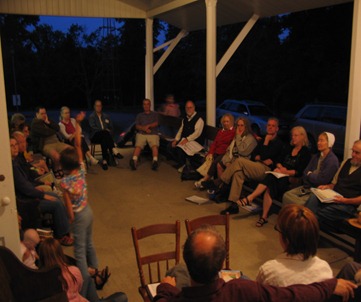
As I mentioned in my previous newsletter, I have sought to spiritually prepare myself during these past weeks for the annual sessions of Great Plains Yearly Meeting, which took place 4-7 June. It is as if my entire year had been inclining towards this moment, the yearly meeting being to my year what Sunday meeting for worship is to my week. Yearly Meeting time is a moment to pause and discern with the wider body of Friends what God is calling us to in the coming year. I went into the sessions holding before God my ministry among Friends in this region, and asking God to guide me and Faith as to the next steps in our walk in Christ. As a part of this discernment, there was a review of the past year's ministry with GPYM's Ministry and Counsel. We heard from my Oversight Committee, as well as from representatives from each Monthly Meeting in the Yearly Meeting about how they had experienced my ministry.

Finally, Ministry and Counsel considered the future of my ministry in the Great Plains. It quickly became clear that some Friends in the Yearly Meeting were out of unity with my ministry. Some were uncomfortable with their perception of my theology. Some did not see how my work fit into our current model of ministry - there's really not an easy "job description" for what I am engaged in. Some were uncertain of how they felt about free gospel ministry - witness to the Seed of Christ in all people, in the tradition of the Apostle Paul and George Fox. A visiting Friend pointed out that Great Plains Yearly Meeting had a choice: We could stick to our status quo of routine and ritual; or we could embrace an apostolic ministry, which would not fit our current plans, but which would shake us up and call us to deeper faithfulness as a Church. The road that we were on, this Friend insisted, would lead ever downward into stagnation; but the apostolic ministry builds up, even as it challenges our feelings of self-satisfaction and safety.

Ministry and Counsel concluded by drafting the following minute:

Friends are deeply grateful for Micah's faithful service among us this past year. Nevertheless, we do not feel able to lend the kind of support that would enable Micah to continue as a released Friend. Our Yearly Meeting simply is not yet at a place where we can corporately affirm an apostolic ministry. With needs so great and laborers so few, it grieves us not to be able to fully take advantage of Micah's willingness to serve among us.

We are encouraged that Micah continues to feel a burden for Friends in the Great Plains. As we look to the future, we hope that opportunities will present themselves for Micah to continue in service to Friends in the Great Plains. We thus authorize the preparation of a general travel minute to facilitate his continued ministry as way may open. (One Friend stood aside on the authorization of a general travel minute.)

I was initially saddened by this outcome, because I had hoped that Friends would feel led to release me to continue ministry in the Great Plains region. But as it became clear that there was not unity for this, I felt an unexpected joy in my heart. I knew that I had been faithful, and that that was sufficient. I did not (and do not) know what the future holds for me and Faith, but I felt deep certainty in that moment that God's purposes were being worked out in me and that God would provide for tomorrow, just as God is providing for today.

Most of the rest of GPYM was fairly routine, but Saturday evening was remarkable. "The future of GPYM" had been on the agenda for business meeting and was supposed to have been up for discussion during the second-to-last business meeting on Saturday. However, there was so much other business, including the approval of the long-awaited Yearly Meeting Handbook, that business was about to close without discussing our future at all. As the clerk was about to close our sessions, visitor Jonathan Vogel-Borne asked, "what about the future?" The assistant clerk looked at his watch and said, "well, we have two minutes left. Would anyone like to talk about the future?" I was on my feet and at the front of the assembled Body before I knew what I was doing.

I was so grateful for those Friends who were holding me in prayer in that moment, because I was quite disoriented. I just knew that I had to speak to the Body. I tried to calm myself, praying for guidance before I spoke. I told Friends, "I'm going to speak for myself, and I hope that some of God comes out." I told Friends that I was disappointed with them for letting annual sessions slip by without wrestling with our future as a Yearly Meeting. I told them that I was concerned that we have become as formal as the Pharisees or the Christians of George Fox's day, mistaking routine for virtue and form for substance. I told them that I loved them all, and I begged them to humble themselves and open themselves to the presence of Christ in their hearts, to follow that inward guidance. Because the status quo hasn't been working for a long time.

This led to a time of open worship. It was a remarkable time of deep prayer out of which some Friends spoke, encouraging Friends in Great Plains Yearly Meeting not to give up the race, but to press forward in faith. Immediately following that, Friends reassembled downstairs to hear Jonathan Vogel-Borne speak for the third time. Jonathan spoke with reference to Ezekiel and the dry bones, and there was a palpable covering of the Holy Spirit among us, which continued as we returned to open worship. Some gave vocal ministry out of this silence that was distinctly Spirit-led and prophetic. Following this time of deep worship, we continued worship as we sang hymns together.

This was, without a doubt, the most spiritually-active session of Great Plains Yearly Meeting that I have experienced since I first attended in 2004. The air was thickened at times with God's presence, and it was clear that the Holy Spirit was working on us, calling us to greater faithfulness and vision. I do not know what the future holds, but I am at peace. The Day Star shines in the darkness and exposes our strongholds of rebellion. The Lamb's War is underway and Christ's victory is assured. I only pray that we will turn, that we will yield, that we will allow God to shape us into what we were meant to be - a holy people, set apart to do the work of Love in the world.

Next Steps

My summer is looking to be quite intense. I will be in Richmond all this week for General Board meetings. The week after next, I will be helping out with Quivering Arrow Camp, a Friends summer camp for children in Northern Oklahoma, headed up by Brad Wood, pastor of Kickapoo Friends (Mid-America YM). Shortly thereafter I will be leaving Wichita to travel throughout the United States for most of the summer, up until my wedding on September 5th. Among my intended travels are: Evangelical Friends Church - Eastern Region, Northwest Yearly Meeting, and Ohio Yearly Meeting (Conservative). I also hope to visit Friends in Michigan, and may visit other Friends as way opens.

As for after September 5th - God only knows. Faith and I are in active discernment about where we are going to land after the wedding, but this has still not been made clear to us. We hope that God will let us in on the secret soon. We can wait, though; we know God is at work and has a plan for us, even if we can't see it yet.

I pray that you experience the peace of Christ in your midst and in your hearts as we strive together in the work that God has laid out for us.

Your friend in Christ,

Micah Bales