Showing posts with label cross. Show all posts

Thursday, May 23, 2013

I Must Decrease

When I was a teenager and in my early 20s, I was pretty miserable most of the time. For years, I flailed around in search of meaning and purpose for my life. I explored and studied, seeking to find meaning in some philosophy, political system, or great idea. I thought I was willing to sacrifice anything for the truth. Yet, throughout my experience of darkness, loss of meaning and despair, I never let go of the illusion that I was in control of my own destiny. The fortress of my life may have been burning down around me, but I was king of the castle!

When I made the decision to follow Jesus, I encountered a whole new kind of fire. I began to perceive that my choice to surrender my life to God would involve a kind of agony I had never allowed myself to experience before. Startlingly, when I told Jesus that he could have control over my life, he took me up on the offer!

One moment that drove this reality home for me was a conversation that I had shortly after committing to become a disciple. I had done something thoughtless. I was careless with the feelings of another person. I acted selfishly. And when they confronted me about how my actions had been hurtful, I wanted to shrug it off. It wasn’t such a big deal, really, I told myself.

Then came the words I’ll never forget: You talk so much about Jesus, yet you act this way!


Read More

Monday, November 26, 2012

Atheist For God's Sake?

What if atheism were the most faithful response to the life and message of Jesus? What if, rather than an anomaly to be fixed or avoided, the felt experience of God's absence were at the heart of the Christian faith? What if Jesus' sense of abandonment by God on the cross were not merely a lamentable necessity en route to the resurrection, but rather a central part of what it means to live in the horrifying light of the gospel?

In his 2011 book, Insurrection, Peter Rollins argues that belief in an externalized, objectivized deity that "makes everything OK" is the path of religious escapism. Instead, he urges us to strip away the comforting veil that hides the naked truth from our eyes - the reality of pain, injustice and deep existential anxiety. To doubt, Rollins argues, is divine - because it is in the depths of despair that we can come into communion with the crucified Jesus who, as he hangs on the cross, cries out in desolation, "My God, my God, why have you forsaken me?"

This image of Jesus' utter brokenness on the cross is one that Rollins returns to time and again as he drives home his message: There is a god of our imagination that comforts us and makes our lives more understandable, but this god is more fiction than reality. It is a false savior, a security blanket that covers over our deepest anxieties. This god that we create is a projection of our own need to be observed and cared for, to live an existence that is ordered and purposeful, to know that everything will be alright in the end.

Rollins breathlessly invites us to cast aside these god-shaped idols that we cling to in the name of religion. Rather than fleeing our moments of anxiety and groundlessness, what if we allowed ourselves to feel the radical abandonment by God that Jesus experienced on the cross? What would happen if we confessed - first to ourselves, then to others - that we do not understand the universe that we live in, that it does not make sense to us? Paradoxically, Rollins insists that the only way to truly encounter God is to fully experience the desolation of God's absence.

Rollins urges us to strip away all the anti-depressants that we heap on top of the raw terror of human experience. Rather than wrapping ourselves ever more deeply in the security blankets of conventional religiosity, with its assurances of salvation "in the sky by and by," a genuine encounter with the living God invites us to dwell in the Desert of the Real. It is in this encounter that we experience the unvarnished reality of our lives, uncushioned by hope of heaven, fear of hell or illusions about a "nanny god" who will make everything better soon. We stand most truly in the presence of Jesus when we embrace the fullness of his suffering and his love for the world as it is, not as the human imagination would have it be.

This is particularly challenging for those of us whom God calls to proclaim the gospel. What is the role of existential doubt, despair and a felt sense of abandonment by God in this proclamation? Surely, all of us have experienced this sense of groundlessness and loss in our own lives. A sense of God's absence is certainly a regular part of my spiritual experience. Yet, it is not the whole of it.

The God of my own experience - and the God whom we encounter in Scripture - is one who is both near to us and far away. Here is a God who neither coddles us (depriving us of free will) nor abandons us forever (depriving us of hope). Peter Rollins has written a brilliant argument against the coddling, "safety blanket god." How do I integrate this critique? What does it look like to fully embrace the reality of the cross while witnessing to the life of the Resurrection? How can I acknowledge my own experience of divine abandonment while at the same time lifting up the life that lies on the other side. The grain of wheat must die if it is to bear fruit - but there is a joyous harvest awaiting us!

Rollins would have us believe that the resurrection life is nothing more (or less) than loving one another, dwelling in the love that makes God's reality present. It is unclear to me whether Rollins believes that God is an actor in history. For the most part, Rollins seems to view God as an impersonal force (agape love) that we humans can either choose to dwell in, or not. Because Rollins' focus is so intensely on the abandonment that Jesus experienced on the cross, at times I wondered whether he considers the experience of God's presence and guidance to be real. Or is all sense of security, groundedness and peace an illusion that separates us from real engagement with life as it really is?

If I had an opportunity to discuss these matters with Rollins, I feel confident that he would give me well-considered answers that demonstrate a balance between absolute despair and cheap theism that denies the cross. Yet, as the book stands, I wonder whether Rollins takes us a little too far from the reality of God's loving presence - the divine personality and will that is not our own, yet fills our lives with purpose, compassion and the pursuit of justice.

While there are parts of Insurrection that strike me as unbalanced, that is to be expected. A prophet does not give a fair and balanced view of all sides of an issue. The hallmark of prophetic witness is that it hits us exactly where we need to be struck. It may not be fair, but it provides the slap across the face that we need to wake up. Peter Rollins is speaking to a decadent, self-satisfied Western Church that has wallowed for far too long in a cheap gospel that celebrates selfish joy and ignores the poor.

We have sung too many cloying praise songs and heard too many peppy sermons. We have whitewashed our own experience of spiritual emptiness too many times. A church that is unwilling to face its own insecurities and anxieties is incapable of truly embracing those on the margins. This kind of church must shun those who cannot hide their brokenness, because it cannot stand to see its own spiritual condition reflected back. Insurrection urges us to look at ourselves in the mirror, perhaps for the first time. It is a reminder that we must face the reality of our own emptiness and anxiety. Another happy-clappy, "Jesus loves the little children," cheap grace sermon will not get us to the resurrection.

It is only as we enter into the experience of emptiness, futility and death that we encounter the beckoning reality of the resurrection. Rather than sparing us from crucifixion, true resurrection is only to be found as we pass through death into a deeper, truer existence. Peter Rollins writes about this in a way that I find very compelling, observing that even the resurrected Jesus bears the marks of his torture on the cross.

Our relationship with God and our fellow human beings looks very different depending on which side of the cross we stand. Do we bear witness to a post-crucifixion resurrection - or do we want to skip the terror of the cross and dive straight into the after-party? Are we truly ready to follow in Jesus' footsteps, taking on the suffering and despair of the world and offering our lives into the hands of a God who often seems absent? How do we bear the marks of the crucifixion in our own bodies, even as we proclaim the living joy and hope of the resurrection?

Monday, September 10, 2012

Forgiveness

To be a Christian means to forgive the inexcusable, because God has forgiven the inexcusable in you. - C.S. Lewis

Do we cherish a forgiving spirit, and strive to "walk in love, as Christ also hath loved us"? - from the 2nd Query of Ohio Yearly Meeting

Forgiveness is the heart of my faith. Throughout the Bible, God reveals a consistent character - one that is slow to anger and abounding in steadfast love. God repeatedly forgives those who betray him and cause him anguish. In Jesus, I find the highest expression of God's self-giving love and forgiveness. In the face of humanity's hatred, cruelty and selfishness, Jesus suffers and dies to bring about reconciliation between God and humanity, and among all members of the human family.

By living in Jesus - partaking in his life, death and resurrection - I experience a foretaste of the consummation of God's forgiveness and love. There is a time coming when the Lord will "wipe every tear from their eyes" and unite humanity in the unity of the Spirit and the bond of peace. I am invited to live into this reality now.

But I find many barriers to this new way of living. Suffering is real, and my natural reaction to affliction is to fight or flee. When someone wounds me, the urge to strike back or withdraw is almost irresistible. Despite all my experiences of Christ's love and his suffering witness on the cross, my first response is usually not very Christ-like.

When Jesus was accused unjustly, he did not defend himself. When he was beaten, he bore it. When he was nailed to a Roman torture device, he prayed for his tormentors. "Forgive them, Father, for they do not know what they are doing." In his time of greatest agony, Jesus was concerned about the well-being of his executioners.

If this is what is required, "who then can be saved?" Jesus' response to unjust suffering is so awesome; he demonstrates God's ultimate power in weakness. Unlike me, Jesus knows to the depths of his being who he is, and whose he is. Jesus has nothing to prove.

One of Jesus' greatest miracles is that he does not allow his own righteousness and the injustice of his suffering to distract him from the needs of others. Jesus did not deserve what happened to him; he would have been totally justified in defending himself. But instead, Jesus bore shame, taunting and torture, blessing those who persecuted him. He knew that his oppressors needed mercy far more than he did. If that is not power, I do not know what is.

My prayer today is that the living presence of Jesus will guide me into forgiveness for those who wrong me. Rather than succumbing to fight-or-flight mode, I pray for the power of Christ within to shine through me and allow me to bear suffering in a way that shows compassion for those who really need it. I pray for the strength to take my eyes off of my own anguish and to act with love and compassion towards those who hurt me. This seems impossible - but I know that I can do all things through Christ who strengthens me.

What is your experience of forgiveness? To what extent does forgiveness depend on the repentance of the wrongdoer? What is the meaning of forgiveness when another person continues to behave in hurtful ways? Have you experienced unilateral forgiveness as being life-giving and empowering? How have you sensed the Holy Spirit within you, teaching you how to forgive?

Tuesday, May 15, 2012

Humble Me, Lord

Though God calls me for a purpose and promises to walk with me in the Way, God does not promise to ensure my emotional or material comfort. Jesus does not promise that this life of ministry will be pleasant, only that he will accompany me. If I want to be faithful to God's plan for my life, I must first accept that faithfulness may not look anything like success. The Lord does not protect his faithful ones from suffering, only from corruption.

In my experience, one prayer that God answers consistently and immediately is this one: "Lord, humble me." Help me to set my sights lower, smaller, simpler. Teach me to quit making the ministry about myself - even vicariously through my community. Show me how to be truly surrendered, bearing my cross for the sake of the gospel. Allow me to shed my need to "be somebody" in this world - to accept that I am just an "extra" in this great historical drama. No one needs to know my name.

Humble me, Lord. Make me less aware of myself and teach me to attend to the needs of others. Deepen my life of prayer - not to increase my own comfort, but so that I emanate your peace, joy and guileless love to those around me.

Let the same mind be in you that was in Christ Jesus,
who, though he was in the form of
          God,
     did not regard equality with God
     as something to be exploited,
but emptied himself,
     taking on the form of a slave,
     being born in human likeness,
And being found in human form,
     he humbled himself
     and became obedient to the point of
          death -
     even death on a cross.
Therefore God also highly exalted him
     and gave him the name
     that is above every name,
that at the name of Jesus
     every knee should bend,
     in heaven and on earth and under
          the earth,
and every tongue should confess
     that Jesus Christ is Lord,
     to the glory of God the Father.

- Philippians 2:5-11

Friday, April 06, 2012

Resurrection Without the Cross is Dead

Yesterday morning, when I opened my inbox, one email jumped out at me. It was from YouVersion, an online Bible service that I am using to read the One Year Bible on my smartphone. The subject line declared in large, bold letters: "He Is Risen!"

This struck me as a bit premature. It was Maundy Thursday, the day when the Christian community remembers the Last Supper, Jesus' anguished hours praying in the garden of Gesthemane, and his midnight betrayal by Judas and arrest by the religious authorities. On Maundy Thursday, we remember that the Way of Jesus exposes us to persecution and betrayal.

Of course, that is not the part of the story that motivates me. I am not seeking to be abused and betrayed, let down by my best friends and hunted by those in power. I may recognize the necessity of suffering, but by no means do I seek it out. I think most of us gravitate towards the triumphant victory and joy of Jesus' resurrection. Victory is energizing, and we want to be victorious people.

Without the resurrection, of course, the suffering and death of Jesus would lose its meaning. If Jesus was only crucified, but not raised, then we have no hope. The resurrection gives meaning to everything that comes before and goes after it. The resurrection is a resounding statement of God's love for and solidarity with the human family. It represents God's ultimate "Yes" to humanity, bearing our burdens and overcoming them through love.

And yet, without Jesus' ministry and prophetic witness, without his suffering and death, the resurrection is stripped of its power. The joy of Easter without the tears of betrayal and the agony of the cross is a perversion of the Good News. The heart of the gospel is that God, in the person of Jesus Christ, has fully identified with humanity, taking on our suffering, our burdens, our sin. By becoming a human being, by teaching and healing us, and by taking all our hate and violence upon himself, Jesus shows us how much God loves us - enough to suffer and die for those who hate him.

There is a temptation to ignore the incredible love that Jesus demonstrated on the cross. The cross is painful, it is messy, it convicts us of the ways that we continue to crucify Jesus through our participation in a corrupt economic and social order. The cross reminds us that we ourselves are responsible.

If we celebrate the resurrection without remembering the cross, we deny the incarnation. The greatest mystery and joy of the Christian faith is not the mere fact that Jesus rose from the dead. It is that he became one of us, experienced our suffering and died for us - at our hands, no less - so that we might be transformed and healed.

Today is Good Friday, the day when the Christian community remembers Jesus' torture and execution at the hands of the imperial and religious authorities. As we remember the price that Jesus paid to liberate us from bondage, let us also remember that we continue to live in a world where the innocent are crushed by the religious and imperial authorities. Let us examine our own hearts to see where our responsibility lies. Are we like the crowd that screamed, "crucify, crucify!"? Or perhaps we are like the disciples, who scattered and hid when persecution came.

This Good Friday, can we resist the temptation to fast-foward to Easter? Will we choose to see the suffering of the world, and the way that God suffers with us? Can we witness God's love for us in the cross? Let us make the time to remember the agony of the cross, and to reflect on the consequences of love in a broken world. When we embrace the work of the cross, walking with Jesus in his work of reconciliation, we will be able to say with all our hearts, "He is risen indeed!"

Tuesday, January 10, 2012

States and Conditions

I first became a Quaker because of my own personal experience of God. I knew many people who talked about God, but I was always a doubting Thomas - I needed to see and touch for myself before I could believe. And God, with great mercy, granted me this. God showed up in my life, demonstrating love and power in ways that I could no longer deny.

Early on in my journey as a Friend, I had several opportunities to witness God's life and power in the midst of Quaker gatherings, especially gatherings of young adults. In several intense episodes over the course of a few years, I experienced the explosive power of God. Tent revival stuff: Ecstatic states, visions, and times when there was no doubt that the Spirit was speaking directly to us as a community. The Book of Acts came to seem familiar.

Young Adult Friends Gathering at Burlington, NJ - 2007

With such experiences, it would be easy to become a "God-addict." In truth, one major dynamic of my early development as a Quaker was a search for "peak experiences." I wanted to feel up. I wanted to experience God's presence and power; the ecstasy of communion and the assurance of salvation. My faith in God rested primarily on the euphoria of the Spirit's presence.

The truth is, my faith was weak. Rather than being based in a profound trust of my Creator, my faith was built on the shaky foundation of psychological and emotional states. When I felt connected, when the movement of the Holy Spirit was readily apparent to me, it was easy to believe. But things felt very different when the euphoria faded. In the face of the humdrum of everyday life - not to mention the times of darkness, when God seemed distant from me - it was easy to question all of my previous experience of God. Was that all God was? A fleeting rush of hormones?

A major area of growth for my life as a Christian is realizing that God is present in all my states. Just as the Word is alive and active in those moments of ecstatic communion with Christ, the Word abides within us in times of darkness and suffering. God's shepherding presence is not limited to the times when we feel good. The Holy Spirit transcends human emotional states.

In the Quaker tradition, the role of gospel ministers is to speak to the "states and conditions" of our fellow women and men. God is not dependent upon our psychological or emotional states; rather, the Spirit speaks to us in our states and conditions. Whether through the Spirit-led ministry of our brothers and sisters, or through the inward voice of God in our hearts, Christ stands at the door and knocks in whatever condition we are found.

It is definitely easier for me to recognize the voice of God when I am in a positive state of being. Nevertheless, as I seek to grow in faith, I feel called to rely more on Christ and less on my own personal states. Rather than insisting that God provide me with euphoric experiences, I feel that God is inviting me into a deeper, healthier relationship.

I believe that a truly mature relationship with Christ is one in which we can sense God's Word in all of our states and conditions. I am learning to simply be present with reality as it is, allowing Christ to reveal himself not only in the bread and wine, but also in the cross and crown of thorns. If God was present with Jesus in his greatest suffering, surely the Spirit will remain with me in my daily cycles of joy and sadness, depth and shallowness.

Planning Committee - Young Adult Friends Gathering - 2008

Tuesday, December 13, 2011

The Longing is a Gift

The last few months have been jam-packed: Full of tasks to be accomplished. Full of worry. Full of demands, deadlines and stress. My life has been so overloaded that oftentimes there has been little room for contemplation. Even when I have taken time to pray, my heart has often not been engaged. I know intellectually that God is always present with me; but at times it has been a challenge to experience it viscerally.

I know by now that I cannot will myself to feel God's presence. It a pure gift when we experience the joy of Christ's love in our lives, and sometimes that gift is not given. Sometimes, God lets us experience spiritual drought. There are times when we can do nothing but ache for God, knowing how far we fall short.

Blessed are those who mourn

This longing for God is a gift in and of itself. I give thanks for the awareness of my need for God. It is God's grace that allows me to recognize the heaviness of my life; to become aware of the burdens that I stubbornly carry, despite Jesus' promise to lift them from me if I trust in him. 

Blessed are those who hunger and thirst for righteousness.

The life of discipleship is not a simple linear progression towards inward peace and joy. As I take halting baby steps towards becoming more like Jesus, I share in some measure of his suffering. As I seek to live as a child of the light, I must bear the sight of my own darkness. Only by facing my own brokenness can I ever hope to be healed.

Sometimes, the Truth can seem like darkness. But I pray that God will continue to grant me the grace to see that the darkness I experience lies within my own heart. Christ's light reveals it, if I am willing to see; and he will heal me, if I am ready. 

Dear Lord, remind me daily of my need for you, and grant me the faith to receive the transformation your Light brings.

Friday, October 28, 2011

Bless the Police

But I say to you that listen, Love your enemies, do good to those who hate you, bless those who curse you, pray for those who abuse you. - Jesus in Luke 6:27-28

After more than a month of systematic police brutality across the nation, police in Oakland, California ratched up the repression of peaceable assembly and free speech. Using tear gas, rubber bullets and flash grenades, police in riot gear brutally dispersed nonviolent demonstrators. Among those injured in the attacks was Scott Olsen, a 24-year-old veteran of the war in Iraq, who was critically wounded when a police officer shot him in the head with a tear gas canister.

Here at Occupy DC, we have been extremely fortunate in our good relations with the several police services that operate in our city. Our interactions with police have been generally cordial, and we have not felt threatened in any way. The police violence that our friends in Oakland - and many other cities - are suffering stands in stark contrast to our experience here in DC.

Nevertheless, the crack-down in Oakland has struck a nerve here. We have seen images out of Oakland that make us wonder about the direction our country is choosing. For many, these images have reenforced preexisting wounds (literal and figurative) and anger surrounding police. Many of us are very angry.

This came to the surface on Wednesday night, when folks at Occupy DC rallied in solidarity with our brothers and sisters in Oakland. Folks at the rally were fired up, furious about what had gone down in California. When the police arrived, some of our young men had to be physically impeded to keep them from picking fights with the officers. Lots of emotion; lots of testosterone.

As the repression of this movement grows more serious, it is crucial that we re-commit ourselves to unconditional nonviolence as a movement. The nonviolent occupations around the world are a severe challenge to the powers that be; however, any hint of violence on our part will undermine all the gains we have made. Our moral authority depends on our willingness to be struck rather than to strike; to receive injury rather than to injure. Ultimately, our authority can only be founded on truth and love.

We occupiers are really good at the "truth" part. Most of us have highly developed analyses of the problems facing our country. We do a good job at pointing out what is wrong. But love is harder. Love requires us to lay down our own selfish interests and act for the sake of others. It means seeing the reality of God's love for others, even those who want to do us harm. Real love goes far beyond strategic nonviolence.

When we are grounded in love, we seek the spiritual and physical wholeness of every person. Love empowers us to see the broken humanity of each individual, and to have mercy on each one for Jesus' sake. When we are living in both love and truth, we are able to stand firm in the face of violence without needing to retalitate. We recognize that the violent person is sick - alienated from the love of God - and that we are called to reach out to them with mercy.

To be loving, however, does not require us to be naïve. We understand that the police - and, more importantly, the powers that give them orders - are not seeking our best interests. We understand that the powers are trembling, and that they are willing to do us harm in order to maintain their privilege. We have no illusions about the ultimate allegiance of the police.

But we must love them. It has been pointed out that police are also part of the 99%. Far more important than this, police officers are also children of God. Just like us, they are in desperate need of God's mercy and love. I pray that rather than falling into the trap of fear and hate, we will imitate Jesus who prayed for those who crucified him: "Forgive them, Father, for they do not know what they are doing."

Friday, July 22, 2011

Why Suffering?

I have been gaining great inspiration and insight recently from reading a biography of Mary Teresa of Calcutta. In her letters, Mary Teresa writes with profound intensity and a singularity of gospel commitment. At the same time, she demonstrates incredible humility and self-denial. Teresa is an inspiration to me for the way in which she was so passionate Mary Teresa of Calcutta holding a childand yet so amazingly yielded to Jesus and the work that he gave her, both interiorly and in the world.

I would like to emulate Mary Teresa's witness. Though I must admit that I have no desire to bear the inward cross of spiritual desolation that she did, I see that this intense darkness (and her continued faithfulness in it) was the highest mark of sanctification and union with God. She truly got a taste of Christ's spiritual desolation as he suffered and died on the cross! It was not that God was not present with her. Rather, God was powerfully present in her life, but she could not feel God's love and peace in her soul. She was left desolate, even while living a life of saintliness and union with God. How amazing. How true to the experience of Jesus!

I see that this is what I fear and flee: the dreadful reality of death on the cross. It brings about the resurrection, laying the groundwork for rebirth in Christ. The suffering of the cross is central to God's plan of cosmic redemption. Yet, it is so dreadful to my soul. Terrifying! It represents the death of the willful self, the "old man." But I can see the blessedness of this self-dying in the witness of Mary Teresa. While I cannot bring myself to long for the agony of the cross, I do pray to die to self so that I can live For God So Loved the World...fully in Christ - so that Jesus can come to live fully in me, just as he seems to have done in Mary Teresa.

In the suffering and spiritual anguish of the saints, I see the truth that is incomprehensible to the modern-day western consciousness: I see that God's plan is not centered around human desires, individual fulfillment or happiness. Mary Teresa saw that her suffering could be cosmically redemptive, perhaps different only in degree from Christ's suffering and death. Indeed, as Christ's body, we participate in his atoning (reconciling) sacrifice.(1)

This is radical stuff. I was raised to focus on my own personal fulfillment and advancement. Individual happiness was always the name of the game. But what if happiness is not the point at all? What if suffering is not, in fact, tragic? What if suffering is actually an integral part of the divine plan? This impacts the question of Way Forwardtheodicy. Because, of course, while theodicy technically means "why evil?" in practice it tends to mean, "why suffering?"

While it is certainly right to say that evil results in suffering, it does not necessarily follow that suffering is evil. What if suffering is like an antibody that God has created to combat evil? What if suffering is a God-given part of the cosmic "immune system"? What if suffering is the only path to healing? What would the implications be for those of us (the vast majority, I imagine) who avoid suffering whenever possible?

-

1. See 1 Colossians 1:24

Tuesday, July 12, 2011

Prayer Without Ceasing

Two friends recently passed along this article from the New York Times, which describes a charismatic megachurch in whose focal point is a chain of prayer, praise and worship that has been unbroken since 1999. At their meeting place in Kansas City, Missouri, the International House of Prayer has maintained Prayer Room at International House of Prayerongoing worship services, day and night, for more than a decade. They intend to keep it up until Kingdom come.

As my friend Martin Kelley points out, perpetual adoration has been practiced by Roman Catholics for centuries. Indeed, continual prayer has been a feature of many Christian movements throughout the history of the Church. In particular, it has been a staple of Christian monasticism. The International House of Prayer, however, is anything but monastic in character.

Something I like about International House of Prayer is its outward focus. IHOP is not primarily a contemplative community, but is oriented toward mission to the wider world. Even if I am uncomfortable with some of the directions that this mission takes, I do appreciate that it sees the fruit of prayer as being a sent into the world. IHOP embraces a view of prayer and holiness that changes both the individual and the Church, equipping women and men for ministry. IHOPInternational House of Prayer - Kansas City does not see prayer as primarily a private practice. Instead, prayer is seen as a springboard into Spirit-led action for Christ's Kingdom in the world.

I will confess that I am very skeptical of the ideological basis of IHOP. At the core of the movement lies a fundamentalist, even "dominionist"(1) worldview, with an intense focus on the "end-times." The major reason given for this movement of prayer and worship is to "hasten" the Lord's coming, to usher in the visible return of Jesus Christ to the earth and to establish a visible Kingdom of God.

I myself do long for a final consummation of history and the final victory of the Lamb over the powers of sin and death. I do believe that God is raising Jesus up so that, "every knee should bend, in heaven and on earth and under the earth, and every tongue should confess that Jesus Christ is Lord, to the glory of God the Father."(2) However, I tend to view this process as inward and spiritual. Rather than primarily awaiting the visible return of the Lord, my hope and experience is mainly of Christ's inward revelation and presence, here and now.

Besides the hyper-literalist reading of the apocalyptic portions of Scripture endorsed by IHOP, I am also hesitant about their focus on emotion. God can certainly speak to us through our emotions, but Worship Service at International House of Prayerthese feelings should not be confused for the Holy Spirit. While the emotional highs induced by skillful preaching and beautiful music can be conducive to deepened faith, they should not themselves be confused for faith or the movement of the Holy Spirit.

The presence of God humbles the proud and gives comfort to the oppressed. The movement of the Holy Spirit inspires humble courage, not bravado. As Christ's presence purifies us and draws us deeper into the Kingdom life, we find ourselves not rising higher on the wings of emotion, but instead plunging deeper into the tender, unselfconscious love of our Risen Lord.

Recently, I have been reading "Come Be My Light," a spiritual biography of Mary Teresa of Calcutta, including many personal letters between her and her confessor. The depth and humility ofMary Teresa of Calcutta Teresa's prayer life has challenged me to re-evaluate my own minor efforts at maintaining a connection and conversation with the Lord. Teresa's life was bathed in prayer, and it is clear that this prayer was the foundation of her life and ministry.

I am particularly impressed at the way that Teresa's deep devotional life led her neither to set herself above others, nor to cut herself off from the suffering of the world. Instead, she was led to such a deep engagement with suffering that she seems to have shared in Jesus' thirst(3), and his sense of abandonment by God on the cross(4). For Teresa, rather than serving as a form of escape or emotional catharsis, prayer allowed her to venture more deeply into the suffering of her crucified savior. From this profound, first-hand knowledge of Christ's suffering, Teresa could embrace the poor, sick and dying on the streets of Calcutta. Intimacy with the Tortured Savior gave her intimacy with the tortured lives of the poor and oppressed.

True prayer is done in the power and humility of Jesus' cross. The purpose of prayer is not to exalt us, but to humble, purify and prepare us for lives of servanthood and friendship with those who are poor - either spiritually or materially. As disciples of the CrucifiedPrayer Room in Kigali, Rwanda Yearly Meeting Messiah, prayer empowers us to embrace the suffering of Christ's body.

The life of prayer and holiness that we are called to as God's people is not a matter of establishing Christ's outward rule over the earth. Instead, we are to be inwardly transformed, letting Jesus Christ live fully in us. If we open ourselves to him, he will shine through. Through unceasing prayer, we can become his body. Through our humble lives of self-sacrifice, suffering and service, the Word can once again become flesh. Jesus returns to reign each day in the lives of those who truly love him. As friends of Jesus, let us embrace the mission to which we are called, "completing what is lacking in Christ's afflictions for the sake of his body, that is, the church."(5)

-

1. For IHOP's explanation of their "Dominion Theology," among other things, click here and scroll down.
2. Philippians 2:10-11
3. See John 19:28
4. See Matthew 27:46
5. Colossians 1:24

Tuesday, July 05, 2011

Encountering the Face of Christ in Africa - Micah's Ministry Newsletter #32

Dear Children of Light,

Air travel is an amazing thing, and it took me only about forty-eight hours to get from Gisenyi, Rwanda back to my home in Washington, DC. The ride from Gisenyi to Kigali, and the flightsKisumu Airport from Kigali to Nairobi to London to Washington were very tiring, however. By the time I arrived home on Sunday afternoon, I was ready to sleep for a week. Nevertheless, in the couple of days since I have been home, I have been trying to maintain a regular schedule so as to re-adjust to the US Eastern time zone.

As I sit down to write this letter, I am still loopy from jetlag. I am also feeling rather intimidated at the prospect of encapsulating this month's experiences into a brief missive. So much has happened in the last three weeks. I hope you will forgive me for being a little longer than usual.

It started in England. On 10 June, I arrived in London and spent the night with Friends in Greenwich. I stayed with Simon Watson and his family. I was grateful for the generosity of their hospitality, as they were kind enough to host me for several nights during my trip. I sense that my visit was encouraging for Simon, and I was gratefulRipley Friends for the time that we were able to share together.

The next day, I took the train up to Derbyshire (the English pronounce it "darby-sheer") and visited Friends connected with the Ripley Quaker Meeting, which meets weekly at a local community center. It was a blessing to be with these faithful Friends. I had connected with many of them already through Facebook and Skype, but it was a real gift to spend time in the home of the Lomax family, and to see them face-to-face for the first time. On Sunday morning, we had a favored meeting for worship, with the power of the Lord Jesus being felt clearly in our midst.

This is the way I would describe the whole of my time in England: covered with a profound sense of the presence and power of Jesus Christ. I had many doubts about taking this trip, primarily due to concerns about the ecological damage caused by air travel. Nevertheless, I could not deny the way the Lord's hand was
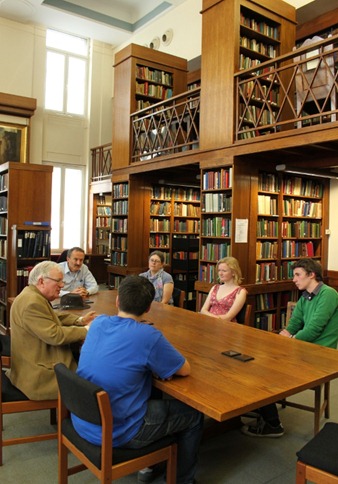
QYPers and John Punshon at Friends Library in London present in my visits among Friends in the UK. Where the Lord sends his servants, he makes the rocky paths smooth and the way straight!

While in England, I was able to link up with the two British leaders from last Year's Quaker Youth Pilgrimage, as well as several of the pilgrims who live in the London area. It was great to catch up with these Friends and see them in their "natural habitat." I was also able to visit Ben Gosling - another affiliate of Rockingham Meeting - and his wife Libertad at their home in Lavenham (in Suffolk). It was lovely to spend time with these Friends, and to get a tour of the historic village they live in, which preserves many buildings from the medieval period.

Overall, I believe that my travels in the United Kingdom were a blessing, both to me and to those whom I was able to visit. For my own part, I feel better informed about the situation that our affiliates in England are facing at this time. The last years have been very hard for the community of Conservative Friends in the UK, and I feel great sympathy for them as they struggle to be faithful in trying circumstances. More than sympathy, I feel conviction that I must examine how God might be calling me to lend support and encouragement to British Conservative Quakers. I sense that this may be a question that Friends in my Monthly, Quarterly and Yearly Meeting may wish to continue to consider together.

Feeling very blessed by the opportunities the Lord had opened for me in England, I took my leave of British Friends to continue on to Africa. Earlham School of Religion, where I work as Coordinator of Young Adult Engagement, was holding a faculty retreat in Kenya and Rwanda. As member of the administrative faculty, I was invited to participate. In addition to the opportunity to spend more time with my colleagues at ESR, I was grateful for the chance to become acquainted with Friends in East Africa. Kenya is home to the largest population of Friends in the world, and I was excited to learn more Lionabout the breadth and diversity of cultural expressions that exist in the modern-day Friends Church.

The first few days of the trip were not business-like at all. We flew into Nairobi and, after a night at the Mennonite Guest House, rode down to the Masai Mara game reserve to spend a couple of days on safari. The safari was a good way to begin the trip, and it was impressive to observe in their native habitat so many animals that I had only ever seen in zoos. Lions, cheetahs, elephants, hippos, and many other species were present in abundance. I took lots of pictures.

As fun as all this was, my own personal priority was to connect with the people of East Africa - especially Quakers. I was elated when we flew out to Kisumu (Western Kenya) and began to visit Friends there. They were not hard to find. In Western Kenya, Quakers are the largest single denomination and ESR Visits Kaimosi Hospitalhave a larger membership than all the Yearly Meetings in North America put together. It was quite an experience to be in a place where the Quaker Church is normative.

While in the area, we visited several important locations. We were able to see the famous Kaimosi Hospital, which I had been hearing about for years as a member of the Friends United Meeting General Board. We also spent several days at Friends Theological College, which is the single most important center of theological education for Friends in East Africa. I greatly enjoyed my time at the school and would like to return some day, as the Lord permits. I was particularly impacted by a visit the house where the first Friends missionaries to Kenya came and began preaching the gospel in 1902. It was amazing and inspiring to stand in the historical epicenter of African Quakerism.

When we had completed our visits in Western Kenya, we flew to Kigali, Rwanda. Rwanda surprised me with how different it felt from Kenya. In Kenya, there were unavoidable signs of intense poverty everywhere; in Rwanda, however, it was a little bit less obvious. The city of Kigali, in particular, felt very developed. Clean, orderly, and apparently relatively prosperous, Rwanda's capital felt similar in Genocide Memorial, Kigali, Rwandamany ways to what I had experienced in the urban areas of Mexico (which is quite a developed country by world standards).

During the week we spent in Rwanda, however, I began to learn about the dark side of Rwanda's apparent prosperity. When I started asking prying questions about the government, I learned that all is not as idyllic as is immediately apparent. One citizen informed me that she felt afraid to make any statement about the government that might be considered negative. However, because we were not in the company of other Rwandans, she helped explain why things look so nice in the cities and along the major roads in the countryside.

Apparently, the Rwandan government requires that buildings be made in a certain style using certain materials. Tile roofs, brick and cement walls - solid, high-quality construction. Expensive construction. I learned that apparently the government not only requires this for new construction, but also has an active program that requires homeowners to upgrade their houses to the new code, especially if their homes are along major thoroughfares that might be seen by tourists. I was told that those who are unable to upgrade their houses to meet government criteria are evicted and have their land confiscated (frequently without any compensation). Jay and EmanuelThe properties are re-sold to those who can afford to improve the land.

The strong hand of the Rwandan government is felt in the life of the Church, as well. Rwanda Yearly Meeting is perhaps the only Friends body in the world that requires water baptism for membership. They do this because the central government will not recognize (or, it seems, tolerate) any church that does not meet certain criteria. One of those criteria is performing water baptism. As an outsider, and a very uninformed one at that, it would have felt wrong to criticize the Friends Church in Rwanda for ceding Friends testimony on this point. However, it is clear that religious freedom is limited in Rwanda in ways that I find difficult to accept.

Our time with the brothers and sisters in Rwanda Yearly Meeting was lovely. They are an amazing group of Friends, who in only a couple of decades have developed a network of sixty churches across Rwanda, as well as an impressive system of schools and programs to give relief to widows and orphans. We were blessed and humbled by Friends' warm hospitality to us. Despite Rwanda's apparent national wealth in comparison to Kenya, it is clear that the common people of Rwanda still live in extreme poverty by most standards. In spite of this, we were welcomed with open arms and treated to lavish hospitality. It was a humbling Friends Meeting House in Rural Rwanda (near Gisenyi)experience to see Friends in Rwanda minister to us out of their material poverty.

By the end of this trip, I was coming to see that it was I who was impoverished. I have had the luxury of so many material and educational advantages by virtue of my family of birth and country of origin. I live at a standard that would be almost unbelievable to most people in East Africa. And yet, I see that I and the society that I live in are poor in the things that matter most. I see more clearly than ever that my own spiritual condition has been that of the church at Laodicea, of which Jesus said, "...you say 'I am rich, I have prospered, and I need nothing.' You do not realize that you are wretched, pitiable, poor blind and naked."(1)

Guilty as charged. I pray for God's mercy, knowing that I have lived so long in material comfort and luxury that I have become blinded to the needs of the poor, marginalized and oppressed. Living in urban North America, it is hard to conceive of what material wealth truly is. Material wealth is having running water and electricity. It is having an educational system that is available to all. It is eating protein every day and having access to a variety of foods. Being rich is owning a cookbook and being able to purchase the ingredients forRural Village Meeting Near Gisenyi, Rwanda any recipe. I have often failed to realize what amazing blessings these truly are. These are things that should not be taken for granted.

I have also seen more clearly what spiritual wealth is. Spiritual wealth is cooking up the best food that you have - even if it is just feed corn, casava bread, rice and beans - and serving it to guests who have traveled from far away to see you. It is only the spiritually wealthy who can show true love by giving generously, wrecklessly - not out of their own abundance, but out of poverty. True, spiritual wealth is welcoming guests, caring for orphans and widows, and seeing that the next generation gets a decent education.

On this trip, I saw the face of Jesus Christ in his Church. I saw the way that our brothers and sisters in East Africa love the Lord, not just through words and easy gestures, but through self-sacrifice Etienneand hospitality that costs something. I saw the radiant joy that comes from holding nothing back, from acknowledging that life is a gift from God that we can never own, only hold in trust.

I have seen so much in the past weeks that has convicted me of my own spiritual shallowness and of the failure of the North American Church to take seriously Christ's call to take up the cross. I am still processing these experiences. I am unsure of where this all leads. One thing is for certain: I am a lot less far along in my walk with the Lord than I would prefer to imagine.

Yet, I also feel a great sense of hope. Among Friends in East Africa, I have seen that the yoke of our Lord Jesus is truly easy, his burden light. If only we here in the North American Church would surrender our own privilege and sense of control, we could share in the easy burden of Jesus. I see more clearly now that I must lay down the burden of control, of self-protection, and of "having David Johns with Childrenenough." I want to follow Jesus, and now more than ever I see that I cannot serve two masters.

Clearly, though this letter has been much longer than usual, there is a lot left to process. I do suspect that I will do a lot of this processing in the coming weeks on my blog, The Lamb's War. I encourage you to subscribe to my blog if you have not already, or just check in from time to time. These experiences will definitely take some time to sort through, and I would welcome your accompaniment on this journey.

Thank you so much for all your prayers as I have been traveling. I have felt safe in my journeys, knowing that the God and Father of our Lord Jesus Christ watches over me and has a plan for my life. I am unutterably grateful for the way God has provided for me thus far, and for the way God continues to teach and guide me. I pray that each of you may experience this same blessing.

Blessings and peace to you in the Lord Jesus,

Micah Bales

-

1. Revelation 3:17

Friday, January 07, 2011

We Are Not In Charge Anymore

Draw near to God, and he will draw near to you. Cleanse your hands, you sinners, and purify your hearts, you double-minded. Lament and mourn and weep. Let your laughter be turned into mourning and your joy into dejection. Humble yourselves before the Lord, and he will exalt you. - James 4:8-10


I ran across this video recently, and I was struck by the state of the American Church as we experience the transition into a post-Christendom context.


On the face of it, I really like this video. I fundamentally agree with pretty much everything Mike Slaughter says. He's right that we need to get serious about being disciples of Jesus rather than just striking a pose on Sunday mornings. I agree that the pseudo-gospel of "accept Jesus and go to heaven" needs to be challenged; and he's right that our words are meaningless unless they are accompanied by transformed lives. Mike says a lot of good stuff that I can unite with. However, as the video ran, I began to feel convicted: Something is amiss here.

A couple of phrases really stood out to me. The first was when Mike talked about us being, "part of a movement that changes the world..." I was convicted of how big I like to talk sometimes. In my joy and enthusiasm, I am apt to run ahead, ready to make declarations about how I am going to change the world. As Jesus noted long ago, this is an easy way to miss all the change that needs to happen within my own heart.(1) The world is indeed in awful shape - but why am I so quick to assume that I am part of the solution, rather than a perpetrator of sin? When I open myself to Wisdom, I see that my own life is on the front lines of the struggle for change. I am humbled, seeing the world I want to change - with its greed, fear, pride and violence - reflected quite clearly in my own life. Changing the world must begin within.

The other part of Mike's sermon that struck me was when he talked about the Church being "effective." Hearing this, I was convicted about how limited my own conception of effectiveness is. When I place my focus on how to be effective, I often lose sight of the things God might be calling me to that do not seem very effective to me. When my primary goal becomes obtaining certain outcomes, I have moved beyond faithfulness and have put myself in God's place.

As my friend Tyler Hampton has pointed out to me, the focus on being able to deliver results reflects how entrenched humanist market values have become in the thinking of the Church. Growth in church membership, number of people fed and clothed in church missions, Bibles translated and distributed, the quality of the music in our services - all of these things are important. If they become our primary focus, however, we have missed the mark. We have adopted a consumer model instead of a Kingdom model.
Of course, we want to be part of a movement that changes the world; we want to be effective. This is as it should be. We should seek to glorify God with our lives, having a positive impact on others. But when "results" become more important than waiting on Christ's guidance and obeying the immediate promptings of the Spirit, we have made an idol of our own understanding. And make no mistake - our claims about "what Jesus would do" are often little more than cover for our own selfish desires.

That, I realized, is our condition as a people. We are still caught up in our long-established habit of using God to justify our own human motivations. We participate in the same triumphalist church culture that most of Christendom has been mired in for the last eighteen hundred years. We see that we are entering into an age of post-Christian culture, yet Christendom is still under our skin. We see the decline of Christian predominance in the West, and yet we believe that the Church is entering into a new phase of influence and high-impact ministry. This reeks of human ideas shrouded in the mantle of God.

And I stand as convicted as anyone. I confess that I would like to be powerful and respected in society at large. I would like my arguments to be persuasive, my methods to be viewed with approval, my assumptions to be validated. However, if we are indeed transitioning into a post-Christian culture, we as followers of Jesus Christ need to come to grips with the reality that our influence in polite society is diminishing.

This should be easier for Quakers to accept than for many Christian groups. We have generally been on the margins of Christendom - frequently persecuted by the wider Church, and, with a few exceptions, rarely permitted to wield much power. And yet, this transition will challenge us, too, because we have grown comfortable and respectable. We share most of the assumptions of the wider society, and as our culture becomes more secular, more focused on products than on people, we will be greatly tempted to follow suit. If we want to stay true to the Lord Jesus, we must embrace our powerlessness. We must allow God's power to shine forth in our weakness, just as Christ did during his self-sacrificial life on earth.

How do we begin to accept the reality that we are weak and uninfluential? How can we embrace our place as a Church on the margins - not only in rhetoric, but in fact? What new opportunities can this afford us to truly be the Church of the Crucified Savior in a broken world?

Lord, show us the way of your cross.

-

1. Matthew 7:3-5

Monday, May 03, 2010

TransFORM East Coast Gathering in DC

I had the opportunity this weekend to participate in a gathering of emergent church leaders TransFORM East Coast Gathering in DC– folks who are involved in or seek to be involved in planting missional, emergent faith communities rooted in the life and teachings of Jesus.  I was able to hear speakers such as Brian McLaren, Peter Rollins, Kathy Escobar and Anthony Smith. I also attended workshops on Christian ecology; turning Jesus’ teachings into living practice as a community; developing new Christian communities alongside more traditional congregations; and a discussion on the way forward for Christians who are neither willing to exclude queer folk from the Church, nor downplay our respect for Scripture. Finally, and most importantly, I was privileged to connect with folks from all over the country, including quite a few from my neck of the woods.

The most spiritually-charged and powerful moment for me this weekend was Friday evening, when we gathered to hear Peter Peter RollinsCollins preach.  He spoke to us about the importance of doubt in our walk with God. Rollins observed that Christ himself cried out in doubt on the cross, and he emphasized the need to release our comforting beliefs and sense of identity, because they in fact separate us from God. God is Truth, not our limited and self-serving conceptions; the Truth – as terrifying and incomprehensible as it can be – must be a the center of our life in Christ. To place our own beliefs and desires at the center is to replace God with an idol, and to dodge the suffering of the cross, which we as Christians are called to bear with our Lord.

Peter Rollins believes that our worship together should reflect the “dark nights of the soul” – our times of spiritual despair, doubt, and sense of separation from God. Our corporate worship can tend to focus exclusively on our experiences of assurance and connection with God; but Rollins encouraged us to consider the role that acknowledgement of suffering, darkness and doubt might play in our shared life as church communities.

To give us a taste of what this might look like, Rollins asked Vince Anderson and Amy Moffitt to perform a song from the Ikon communityMusic in Ireland, where Rollins serves. It was a hymn of darkness, despair, loss and doubt. To be honest, it made me feel very uncomfortable. As the hymn came to a close, though, something remarkable happened. The Holy Spirit descended on us, and the entire gathered assembly was still and silent, hushed with awe. This was a clapping group, which normally gave applause after every event – but after this hymn, no one moved.

The awed silence was broken after a short while by the facilitator, wanting to move us along in our evening program. I felt grieved that the work of the Holy Spirit was being brushed aside. Others certainly felt this way, too. A man rose from the audience, interrupting our facilitator, “Thy kingdom came!” I heard voices say, “Amen!” The man continued to address the facilitator, “can we acknowledge the grace of God among us for a moment?” After perhaps a minute more of silent reverence before God, the facilitator again took up the schedule.

When we were dismissed a few minutes later, a young woman rose from the audience, interrupting folks as they greeted oneTransform another. She invited anyone who wanted to pray to join her at the front of the sanctuary where we were gathered. Faith and I immediately rose and followed her to the raised area at the front of the room. Five of us gathered in a circle while the rest of the group socialized and made their way out of the building. We took turns praying aloud as we were led. Praying for the gathering; that God to continue to pour out the Holy Spirit on us; asking forgiveness for the way in which we had turned away God’s presence from our midst. I feel so grateful for the way in which a few of us were drawn together in the Spirit in that moment to cry out to God and intercede for the Church.

I am in awe of how I see God at work in the wider Church, despite our failure to fully embrace the Spirit’s work in our midst.  I feel grateful for the connections that I have made this weekend with other followers of Jesus, both here in the DC area and acrossBrian McLaren addresses us North America. I had never been exposed to the emergent church movement before, having focused almost all of my attention on the Quaker community in the years since I became a Christian. As a result of this gathering, I feel energized to engage with emergent Protestants; both to learn from them and their experiences as disciples, and also to share with them the rich heritage of Quakerism, which informs my own walk with Christ. Together, I believe we can grow into more faithful friends of Jesus.

A few relevant links: