Showing posts with label early church. Show all posts

Tuesday, February 19, 2013

The White-Hot Gospel

The early decades of the Christian movement were infused with a radical sense of a new Kingdom that turns the whole world upside down, but things changed as the Church began to settle into life in Empire. It is tough to swim against the current of the dominant culture. As time went on and the expectation of Jesus' second coming gradually diminished, the followers of the Way began to adapt to the expectations of Greco-Roman society. Decades passed, and Jesus still had not returned to establish his outward reign on earth, so the Church began to develop a meantime theology, seeking to live peaceably - and unobtrusively - within the Empire.

This made all kinds of sense. After all, Rome regularly carried out persecutions against those who refused to submit to the cosmopolitan religion of the Empire, to worship the Emperor as a god. Christians were already in very serious trouble much of the time. Under such circumstances, the temptation to blend in and do as the Romans do must have been huge.

But this decision to compromise with the surrounding culture came at a price. The white-hot gospel of Jesus upended the social hierarchies that were so integral to the internal logic of Empire - master above slave, lord above servant, husband above wife. Yet, as the Christian community struggled to get along in the Empire, all of these harmful dynamics reemerged in the life of the Church. Why?

The radically counter-cultural gospel of Jesus simply could not coexist with the Church's compromise with the unjust culture of the Mediterranean world. The only force that was able to hold this explosive witness together was the intense experience and expectation of Christ's presence and coming Kingdom. A new Order was coming that would replace the old ways of Empire.

But the years passed. Decades went by without the outwardly visible return of Jesus that the community had assumed would take place. Jesus did not come riding on the clouds, taking his seat on the throne of David and establishing a millennial kingdom for all the world to see. Gradually, much of the Church lost a sense of Christ's immanence. Jesus became someone out there, beyond the sky. His Kingdom became a distant reality, something that would eventually take shape at some point in the future - but certainly not today. For much of the Christian community, Jesus became a myth rather than an experienced relationship.

This feeling of distance from the Kingdom of God has made it even more difficult to resist the relentless pressure of Empire. It may be precisely because the Church has experienced and proclaimed God's Kingdom as existing only in a far-off heaven that we have been so susceptible to the distortions and compromises of a long succession of human kingdoms.

As long as the followers of the Way had a sense of Christ's living presence and power in the world, miracles happened. The sick were healed, the dead were raised and the poor had good news preached to them. Men and women entered into their originally intended state of full equality, just as they had been before the Fall. Jesus - not as mythical figure in some distant heaven, but as a viscerally present Teacher and Lord - broke down the divisions between Greek and Jew, slave and free, male and female. In this imminent experience of his Kingdom, all became brothers and sisters, functioning together as a living and growing body.

It is this astonishing reality that the early Quaker movement tapped into. Rather than looking to a distant Kingdom in the clouds, they experienced and proclaimed that Jesus had come to teach his people himself. The Kingdom of Heaven had come near, and all bets were off.

It was in this way - through the experience of Jesus himself, living within each believer and in the midst of the gathered community - that the Quaker movement was able to re-discover the radical equality of Christ's Kingdom. In an age of deep patriarchy, Quakers spiritually empowered women just like the earliest church did. Women served as elders, apostolic ministers and evangelists. Women and men labored side by side for the radical gospel of the Risen Jesus, and all were free to preach as the Spirit gave the words.

This powerful experience of Jesus is available to us today. It is this personal and community experience of God's life and presence that can break us out of our fallen addiction to racism, patriarchy, homophobia and all the many ways that this world encourages us to marginalize one another. When we walk in the light of Christ's Spirit, God gives us power to resist the injustice and false assumptions of our present culture, this current manifestation of Empire.

Are we ready to embrace the white-hot gospel of a present and living Kingdom? Are we prepared for the subtle and radical ways that the Holy Spirit calls us to live in contrast to the dominant culture? Do we have the courage to embrace the love that raises up the lowly and humbles the proud? Is today the day when we will meet the Risen Lord for ourselves?

Thursday, November 29, 2012

Should Quakers Be Laying On Hands?

Now when the apostles at Jerusalem heard that Samaria had accepted the word of God, they sent Peter and John to them. The two went down and prayed for them that they might receive the Holy Spirit (for as yet the Spirit had not come upon any of them; they had only been baptized in the name of the Lord Jesus). Then Peter and John laid their hands on them, and they received the Holy Spirit. - Acts 8:14-17

Have you received the Holy Spirit?

The Book of Acts describes how the first disciples in Jerusalem experienced the coming of the Spirit, and this outpouring quickly spread to thousands of others. It was not long before the Church in Jerusalem was scattered by persecution, but this just spread the gospel message more widely.

One of these scattered disciples, Philip, shared the good news in Samaria. The Samaritans were the red-headed stepchildren of the Jewish family. They were outsiders par excellence, widely considered untouchable heretics by their Jewish neighbors. Yet, perhaps because of their shunned status, Samaritans were eager to embrace the news about Jesus. They heard the message and accepted it.

The new believers in Samaria took the first step, being baptized with water as a symbol of their whole-hearted embrace of the message that Philip had shared with them. But there was still something missing. The leaders of the Church in Jerusalem knew in their bones that the people of Samaria needed more than human belief in the message about Jesus: They needed to experience Jesus for themselves. They needed to taste his very Spirit.

What does that even mean? Why weren't the apostles satisfied with the fact that the Samaritans had become "orthodox Christians"? What compelled some of the apostles in Jerusalem to venture out to Samaria and lay their hands on the new believers? And why did the Holy Spirit wait for the apostles' touch before indwelling the new church? If the Spirit blows where it will, what need is there of human intervention?

There is a reason that our spiritual ancestors used such rich, diverse language to describe the Spirit: A dove descending from the sky, rushing wind, tongues of fire, living water, the sound of silence. All of these words offer a window into the mystery of the Holy Spirit, the source of a Life and Power so magnificent that our faith is incomplete until we receive it.

It is my experience that the Spirit is beautifully mysterious and unpredictable. Any attempt to pin her down and force her to obey human regulations will fail. And yet, this story of human involvement in the work of the Holy Spirit rings true to me. It fits with my own experience of receiving the Holy Spirit into my life.

When I first became a Quaker in 2004, I did so because I was convinced at a very deep level, far beyond simple intellectual assent, that the testimonies of Friends were true. I could sense that there was a ground of truth that was solid and immovable. I sensed that God was real, and that my life needed to conform to that Truth. Yet, there was something missing. While I had begun to accept Friends principles and could sense God's hidden presence, I did not experience God as an actor in my life. In reality, I was still in the driver's seat. I was "exploring God," like the famous old blind men who could each feel a different part of the elephant.

But when the Holy Spirit came on me, it was as if that elephant reached out and grabbed me with her trunk! No longer was God an object of my personal study; I came face-to-face with a divine Presence and Personality that had plans for me, and who would guide me if I opened myself. I was shown, in a deeply personal way that can never be fully explained, that God is not an "it," but rather a "thou."

And how did I come to have this experience? What was the catalyst for this encounter with the divine Thou? While for me there was not a literal laying on of hands, the circumstances surrounding my reception of the Holy Spirit bore great similarities to the experience of the Samaritan church.

I was at the World Gathering of Young Friends, in Lancaster, England, together with hundreds of other young Quakers from around the world. During the gathering, we heard sermons from a variety of ministers. One of these, a fiery preacher from Philadelphia, challenged us to know who we were and to accept the mantle of prophecy that the Spirit was calling us into. Early on in her sermon she warned us, "you didn't ask me, but I'm about to give you a double portion of what I have." At one point - referencing the words of Jesus in John 15 - the minister exclaimed, "you're cleansed!" She spontaneously grabbed a container of water that was sitting up at the podium and began sprinkling those of us sitting closer to the front.

The sermon was riveting. It was the most explosive, powerful vocal ministry I had ever encountered. She spoke directly to our condition that evening, and the Spirit was palpably present in the room - though I was not consciously aware of it at the time.

It was later in the evening that it happened. I was sitting on a bench with another young Quaker, and we spontaneously fell into silent worship together. Suddenly, the Holy Spirit was upon us, bathing us with wave upon wave of light, power, love and tender mercy. There simply are no words. But every true word I have spoken since that night has flowed from this Source.

I am convinced that the presence of apostolic authority and blessing that night were instrumental in the work of the Holy Spirit. The faithfulness of this minister from Philadelphia played the same role for me as Peter and John did for the new believers in Samaria. It is enough to make me wonder whether we Quakers should put more emphasis on the importance of human participation in the gift of the Holy Spirit.

Has this happened to you? Has someone laid hands on you - literally or figuratively? Have you received a blessing from another person that has allowed you to plunge far deeper into relationship with God than you ever had before? What do you think the role of human agency is in the ministry of the Holy Spirit? Could it be that we Quakers need to be more open to sharing the gift of the Spirit by the laying on of hands?

Saturday, May 26, 2012

I Will Remember

Therefore, since we are surrounded by so great a cloud of witnesses, let us also lay aside every weight and the sin that clings so closely, and let us run with perseverance the race that is set before us, looking to Jesus as the pioneer and perfecter of our faith, who for the sake of the joy that was set before him endured the cross, disregarding its shame, and has taken his seat at the right hand of the throne of God. - Hebrews 12:1-2

Tomorrow is the day that the Christian community celebrates Pentecost, the birthday of the Church. It was on Pentecost that the followers of Jesus in Jerusalem received the Holy Spirit. The Spirit's coming united the early Christians at the deepest level, in a living experience of God's presence and power. They were transformed from a loose collection of individuals into a new creation, a vibrant community that was of one heart and one mind. Jesus sent the Spirit of Truth, just as he promised, and this Spirit-filled human community became his continuing presence in the world, the Body of Christ.

This year, the celebration of Pentecost falls on Memorial Day weekend. This unusual alignment of these two days of remembrance has spurred me to do some thinking about the relationship between Memorial Day and Pentecost. The former is traditionally a celebration in remembrance of those who have given their lives in military service, while the latter commemorates the in-pouring of God's Spirit into the world. Many Christians will celebrate these two days side by side, without any sense of contradiction.

I cannot do that. As a Quaker, I believe that when Jesus Christ disarmed his disciples in Gethsemane, he disarmed the Church. I believe that when Jesus died on the cross, he set an example for those who would follow him - taking on suffering rather than inflicting it, blessing those who curse us. As a follower of the Crucified Savior, I must remember the martyrs - those who sacrificed their own lives, possesssions and comfort in order to demonstrate God's love to a world in pain. This Memorial Day, I will remember the faithful servants who have gone before, joining Jesus in blazing the trail that I now walk.

I will remember those like Stephen, who was put to death for his witness to Christ's love and justice. I will give thanks to God for the faithful service of Paul of Tarsus, Francis of Assisi, George Fox, James Nayler, Edward Burrough, Margaret Fell, Tom Fox, and all those who have suffered for the Truth. Whether by a martyr's death or simply through handing their entire lives over to the work of Christ in the world, they paid the ultimate price for their faith.

I will remember the way that so many have laid down their own privilege and comfort to serve the poor and the lost. And I will remember how I was one of those lost ones. I will give thanks for the grace these servants of God showed, loving me in spite of all the ways I pushed them away.

I will remember Dorothy Craven, who lived a life of simple faithfulness and gentle love for all people. I praise God for the way she laid aside her comfort and walked in faith with the Friends of Jesus commmunity in Wichita, Kansas. She served as an elder to us, a mother in the gospel. She introduced me to the writings of Thomas Kelly and taught me Algebra, even though I was probably the most frustrating student she ever had. She loved me when I did not deserve it. She believed in me when there was no good reason to do so. She was Jesus to me.

Dorothy has now joined that great cloud of witnesses that surrounds me. Sitting at Jesus' right hand, these faithful witnesses call me forward. They spur me to greater courage and vulnerability in love. They are my heroes, and I experience them as being somehow, mysteriously alive in the Spirit that unites us. This Memorial Day, I will remember these holy ones who stand, unarmed, by the throne of God. Together with Jesus, they call me into a life of fearless love and peace. This Pentecost, I will celebrate the Holy Spirit that unites us beyond life and death.

Who are the witnesses that call you forward?

Tuesday, May 22, 2012

All Things To All People

To the Jews I became as a Jew, in order to win Jews. To those under the law I became as one under the law (though I myself am not under the law) so that I might win those under the law. To those outside the law I became as one outside the law (though I am not free from God's law but am under Christ's law) so that I might win those outside the law. To the weak I became weak, so that I might win the weak. I have become all things to all people, that I might by all means save some. - 1 Corinthians 9:21-22

The ancient society where Christianity emerged consisted of a wide variety of local cultures, all united under Roman rule. Greeks and Jews mingled, and the cities of the Empire allowed a cosmopolitanism that had rarely existed before in Western history. The early followers of Jesus were challenged to share the gospel message in a context where all truth was relativized under the coercive power of the Roman state. In that society, people could worship whatever gods they chose - so long as they also worshiped Caesar.

I also live in a society where people worship a variety of "gods" and participate in many subcultures and lifestyles. Yet, just as was the case in ancient Rome, the modern-day empire I live in is held together by a set of common assumptions. Although no one is required to literally worship the State or its rulers, this society is held together by the veneration of wealth and the exercise of political power. All of us, from smallest to greatest, are caught up in an economic and political system that demands our allegiance just as surely as Caesar ever did.


The God whom I worship, and the gospel that I proclaim, stands in stark contrast to the worship of wealth and human power that lies at the center of American society. The "upside down Kingdom" of Jesus reveals the weakest to be the strongest and that those who put themselves first may find themselves left out. The good news of Jesus represents a direct challenge to the core assumptions of this present age.

This is scary stuff. It is not accident that the rulers and authorities of ancient Rome brutally tortured and executed Jesus, and continued to persecute Jesus' followers for centuries. When we directly confront the foundations of Empire, we should expect a response that is in keeping with Empire's way of doing business.

Despite all of the persecution, torture and summary executions that the early Christians faced, the early Church did not condemn the whole of Greco-Roman society. On the contrary, the early Christian community made great efforts to communicate the good news in terms that would speak clearly to the wide variety of cultures and experiences that made up the ancient world. Rather than insisting that everyone become a Jew, the disciples proclaimed a new way that was open to all people, regardless of their ethnic or cultural affiliation.

As Paul explained in his letter to the Ephesians, the mission of the early Church was to proclaim a gospel that reconciled women and men from all sorts of backgrounds, whether Jew or Greek, uniting them into one new humanity. This new spiritual community did not have the effect of eliminating cultural differences; on the contrary, the cultural diversity of the ancient world remained, but it was placed on a new foundation. Rather than worshiping the wealth and power of Caesar, all the nations of the earth would now join in worshiping the one true God!

How can I share the good news in ways that affirm the diversity of culture, language, identity and experience that I encounter in my city? How can I lift up that which is good in my cosmopolitan society, while at the same time challenging the harmful foundation of greed and pride that has taken us captive? How can I model and preach a gospel that, rather than eliminating our differences, places all of us on a new foundation in Jesus?

Friday, April 13, 2012

The Burdens We Cannot Carry

It would be fair to say I have a lot of balls in the air. In addition to the work I do for Earlham School of Religion, I am involved in planting a new Quaker Meeting, doing foreclosure resistance with Occupy Our Homes DC, organizing with Occupy Faith and Occupy Church, and meeting various responsibilities within the wider Quaker community. Recently, I realized that each week I probably spend about twenty hours in meetings across the city - not including the time it takes to commute between them! Add to this all of the one-on-one appointments and out-of-town trips that I take, and just building and maintaining relationships has become a full-time job.

I have heard that Martin Luther once said, "I have so much business I cannot get on without spending three hours daily in prayer." I see the truth of this. Though I do not yet spend three hours a day in prayer, as the intensity of my daily schedule grows, so too does my need for time alone with God. Without a steady discipline of waiting worship, song, Scripture and writing - without taking time each day to focus only on Christ and his will for me - I would be lost in a flood of anxiety.

I know that I am not the first one to experience this. Examining Scripture, it seems that this type of daily discernment has been going on since the beginning of the Church. I find this passage from Acts 6:1-4 particularly striking:

Now, during those days, when the disciples were increasing in number, the Hellenists complained against the Hebrews because their widows were being neglected in the daily distribution of food. And the twelve called together the whole community of the disciples and said, "It is not right that we should neglect the word of God in order to wait on tables. Therefore, friends, select from among yourselves seven men of good standing, full of the Spirit and of wisdom, whom we may appoint to this task, while we, for our part, will devote ourselves to prayer and to serving the word." (Acts 6:1-4)

There was so much work to do within the early Christian community that the original twelve apostles were unable to keep up. There were thousands of people living in intentional community with needs to be met. The demands of logistics were clearly enormous, and yet just twelve men were being expected to carry the entire burden. Clearly, something was wrong with this picture!

It would be silly to pretend that I have as much on my plate as the twelve apostles did. Nevertheless, I do draw inspiration from the example that they set. They saw clearly that they were not capable of fulfilling every role within the community, and they had the wisdom invite the gifts that were present in the rest of the Church. There was no way that the twelve could manage the logistical needs of the burgeoning community in Jerusalem while at the same time preaching the good news of Jesus Christ throughout the city and the region. The apostles were clear that God was calling them to focus on sharing the gospel, and they had the foresight and humility to say, "We cannot do everything. We need help."

As my life fills with increasing responsibilities, I am routinely called to take a step back, humble myself in prayer, and ask God what it is precisely that I am called to do. There is usually just a small cluster of tasks that God is directing me to at any given time. By grounding myself in a daily practice of seeking God in prayer, submitting myself to the guidance of the Spirit, I am able to lay down everything except that particular handful of tasks that God is calling me to.

When I trust in Christ's guidance, he preserves me from burn-out. He gives me the strength and energy I need for the work he has called me to. Equally important, God gives me the opportunity to empower others to live into their own particular callings. When I try to do everything, I often get in the way of others, taking over where they should be leading. By faithfully attending to the particular role that God has assigned me in this moment, I can create space for others to exercise their gifts, as well.

How do you balance the many demands of work and social responsibilities? What is the place of prayer, study and reflection in your daily life? How have you learned to say "yes" to the service that God is calling you to, while encouraging others to pick up the pieces that you cannot carry?

Tuesday, February 07, 2012

Time to Occupy the Church

Ever since becoming a Christian, I have read in the Book of Acts about the radical fearlessness of the early Church, and I have long been inspired by the witness of the early Quaker movement, which cast aside comfort and privilege to shine a light on all the forces that held women and men in misery. Yet, I had never myself seen this kind of communal faithfulness in action. It took an apparently secular movement like Occupy Wall Street to help me really understand, on an experiential level, what an authentic movement for justice and righteousness could actually look like.

The Occupy movement is based in a sense of indignation that a tiny elite of our wealthiest citizens and their corporations have virtually monopolized the political discourse in this country. Elections have devolved into auctions, with the candidate who is able to raise the most money from corporate sponsors almost always emerging victorious. As public opinion is increasingly swayed by massive corporate propaganda campaigns, all semblance of real democracy is slipping away. The Occupy movement names these truths, revealing them in bold acts of street theater. It creatively disrupts the careful choreography of the wealthy elites and their servants.

The Occupy movement is playing a prophetic role in our society. It has ripped away the thin veneer of legitimacy that previously masked the criminal actions of the corporate powers and their bought-and-paid-for politicians. For those with eyes to see and ears to hear, the occupiers have revealed the true condition of our nation.

It is amazing to see how God is using the most unlikely of characters - anarchists and homeless people, young idealists and unemployed construction workers - to call our attention to the truth. Those whom our society has rejected have been chosen to serve as the national conscience.

This has Jesus' fingerprints all over it. Jesus always got push-back from the respectable people of his day - religious and community leaders - for spending his time with tax collectors and sinners, lepers and prostitutes. Jesus not only mixed with people whom his socity deemed dirty and worthless, he called them his friends. Jesus invited the lowest of the low to become friends of God. He empowered society's outcasts to reveal God's love, mercy and justice to the world.

The Occupy movement is not made up of the "important" people of our day. Religious leaders in particular have been cautious about getting too close to this risky group of people who are speaking truth to power. It is one thing to preach a sermon on peace from the safety of the pulpit - it is another thing entirely to put our bodies and reputations on the line to advance the cause of truth and mercy in our communities. So far, most church people have not been ready to take the plunge.

I do believe, however, that God is calling the Christian community to get out of our comfort zone, to invest ourselves in the struggle for economic justice and genuine democracy. We can no longer hide behind a false neutrality that only emboldens the predatory behavior of the wealthiest and their corporations. When a bully is hurting your friends, you cannot be neutral. There are villains in this story, and they must be confronted.

Far too often, we ourselves have been the villains. Through selfishness and cowardice, we have participated in the systems of injustice that are choking the dignity of millions. Perhaps this is one reason that we are so reluctant to commit ourselves in this new movement. If we are to stand up for truth and righteousness, we will be forced to acknowledge the ways in which we have fallen short. We will be forced to change.

This is hard. It is a process that will take years and decades. But I am convinced that we must start now. We, the ecumenical Christian Church in the United States, must take up the frightening responsibility of living and proclaiming the uncompromising love and prophetic justice of our Lord Jesus Christ. It is only by participating in his mission to liberate the poor and oppressed(1) that we can ever hope to be his disciples.

This Thursday evening, at 7:00pm, some of us who desire to become more faithful disciples of our homeless Savior(2) will be gathering at New York Avenue Presbyterian Church in Washington, DC. We call on Christians of all denominations and communions to join with us in issuing a call to repentance and renewal of faith in the God who stands with the poor and the powerless. Together, we will seek to embody the love, strength and courage of Jesus Christ through positive action for justice, reconciliation and peace.

If you are in the DC area, please join us. If you are in another region, please pray for us, and consider holding a similar gathering in your area. As followers of the crucified Messiah, we can no longer be silent. The time has come to Occupy the Church.

-

1. Luke 4:18-19
2. Luke 9:58

Friday, November 18, 2011

The Long Haul

Mike McKinley, pastor of Guilford Baptist Church, writes, "Young men tend to overestimate what they can accomplish in the short term and underestimate what they can accomplish in the long term." This has certainly been true in my own life.

I am a very passionate person; and when I set myself to a project, I want to see immediate results. When Faith and I founded Capitol Hill Friends, I imagined that we might get the Meeting up and running within a year or two. By year three, surely, the church would be ready to stand on its own, whether Faith and I could stay or not.

I can see in retrospect how much my expectations and imagined timeline revealed both my impatience and my ignorance of how human community actually works - or, perhaps, how it does not work - in 21st-century urban America. I thought that with a little determination and elbow grease I could start a new church and move on in just a few years. If George Fox or the Apostle Paul could do it, why not me?

It is easy to see now how naïve I was. I believed that the needs of post-modern America were essentially the same as those of 17th-century England, or the 1st-century Roman world. What I did not understand was that the ministry of Paul and George Fox took place in an environment where people were already organized into organic communities. These communities needed to hear the truth; but no one needed to teach them how to live as members of a community as such.

Our situation today in the post-industrial West is different. Most of us are locked into a society that is so intensely individualistic that our ability to live in community is severely hindered. Extended family networks and friendships are strained and broken through the unceasing quest for more money, status and personal well-being. Most of us no longer have any concept of what real community might look like; or, if we do, we are repelled by it. Community can seem like poverty when we are used to being autonomous individuals, ruled only by our appetites and our need for money.

In such an environment, simply sharing the good news of Jesus is not enough. The evangelist must demonstrate a new way of living that draws women and men into stable, committed community. In a society such as ours, genuine community is a striking witness to the power of the gospel.

This witness requires a different model of ministry from that of Paul or George Fox. I believe that the work that God is calling me to has far more in common with that of Benedict of Nursia. Benedict is considered the founder of Western Christian monasticism. He lived and ministered during the collapse of the Roman Empire, when civilization was falling apart and human community was in great danger. In this context, Benedict offered a new way of life - a disciplined community in which women and men could live faithful Christian lives. In the midst of social chaos and confusion, Benedict held a space for community rooted in obedience to Jesus Christ.

In many ways, Benedict provides a more helpful model of ministry for my historical context. However, I must admit, it is a tough pill to swallow. Frankly, I find the ministry of Paul and George Fox to be far more exciting than that of Benedict. I would rather hop from place to place, preaching and helping to gather a far-flung movement. Benedict's discipline, on the contrary, terrifies me with its admonition to stay in one place indefinitely, cultivating faithful community year after year, decade after decade. Frequently, however, God teaches me and helps me grow through those things which most challenge my natural inclinations. Though I find Benedict's model less appealing, I sense that it fits better with what God is calling me to.

I am convinced that the work that is needed here in Washington, DC is not primarily the fast, mobile ministry of George Fox or Paul. Instead, I believe Christ is calling me to the slow, patient work of cultivating the vineyard of God's people. I am here for the long haul. As long as it takes. As long as God requires.

Friday, March 25, 2011

Primitive Christianity Revised?

For most Christians, there is an assumption that the faith and practice of the early Church bears a certain special authority. Some communions express this in doctrines of "apostolic succession," in which the modern-day Church receives its spiritual authority as an inheritance, passed down from the first-century apostles to the present-day church leadership. In other denominations, the canonical Scriptures are understood as bearing this fundamental authority. The Scriptures transmit the story of the life, teaching, death and resurrection of Jesus Christ, and they also provide us with a glimpse into the life of the early Church. The early Church, as we encounter it in Scripture, serves as a model for us today.

The Religious Society of Friends also gives priority to the early Church. The first-generation of Quaker preachers and evangelists understood themselves as a re-emergence of the true, spiritual Church of Christ. One of the principal slogans of the early Quaker movement was "primitive Christianity revived." Early Friends claimed that the Church had fallen into apostasy in the centuries since theClement of Alexandria events detailed in the Book of Acts, and they believed that the new Quaker movement represented not a new sect, but a rebirth of the first-century Church.

The interesting thing is, in many matters of practice, the Quaker movement diverged from the pre-Constantinian Church. The early Church practiced water baptism, for instance. And the Lord's Supper. Within the first few generations of the Christian faith, there were clear hierarchical lines of authority established within the Church spreading throughout the Roman Empire. There were priests and bishops, very similar in their function to the priests and bishops in the Eastern Orthodox communion today.

The Friends movement denied the legitimacy of a human priesthood, calling it a blasphemy against the true and eternal priesthood of Jesus Christ. The early Quakers rejected water baptism, claiming that it was a Jewish rite that no longer applies to those who are in Christ.

Similarly, Friends eschewed the ritual of bread and wine that is so central to most Christians. Jesus, they claimed, never meant to institute a perpetual ceremony for the Church to observe. While the early Friends movement undoubtedly bore the marks of spiritual anointing and apostolic authority, there were many differences between their practices and those of the primitive Christianity that they felt they embodied.

As a twenty-first century Christian in the Quaker tradition, this leads me to wonder about how we as a Church are to relate to our spiritual ancestors - whether they be the early Quakers, the Doctors of the early Church, the Apostle Paul, or the Twelve Apostles or the first-century Church in Jerusalem. How do we makeThe Church Fathers sense of the differences in theology and practice among them? How do we decide who our ultimate guide should be?

If our object is to preserve undefiled the faith and practice of our spiritual forebears, we must first decide which ancestors have primacy. As Quakers, do we privilege the early Friends over the Doctors of the early Church? On what basis? And if we choose to privilege the more universally recognized teachings of the Doctors, how do we make sense of our own tradition as Friends, which certainly differs with the understandings of the early Church on several points?

Most of the denominations that have emerged out of the Protestant Reformation base their faith and practice on a particular interpretation of Scripture. The justification for everything they do is "the clear teachings of Scripture." Scripture trumps the teachings of the early Church - and certainly the teachings of the medieval Roman Church. For most Protestants, Scripture is the foundational bedrock where Christians can go to test all doctrines. Given the plethora of Protestant denominations today, it is clear that this did not provide a complete solution to the question of authority. Ultimately, each denomination stands on its own particular interpretation of what the Scriptures "really mean."

In many ways, Quakers are no different. We have particular passages that we like to harp on. The early Friends focused a lot on the book of James, Hebrews, John and Revelation. Our reading of Scripture is certainly particular, biased, sectarian. We have this in common with the Protestant denominations. The difference, though, is that Friends have always believed - at least in theory -Polycarp of Smyrna that Jesus Christ is literally present with us in the present day. The foundation of our faith as Friends is not the example of the early Church, the early Friends, or even the Scriptures. It is Jesus himself. Here. With us.

Our experience has been that of Paul, who wrote that, "no one can lay any foundation other than the one that has been laid; that foundation is Jesus Christ."(1) The early Church, the Roman and Eastern communions, the Protestant reformers, early Quakers, Methodists and Pentecostals have all built upon that true Foundation. There have been many times that we have gotten it right, and plenty of others when we have messed up and missed the whole point. Jesus Christ, resurrected and present with us today, is infallible; we, his Church, are not.

Sometimes our spiritual ancestors screwed up. Think of slavery. Or the subjugation of women. Despite our failings, however, I believe that our spiritual ancestors have - by the grace of God - gotten more right than we could reasonably expect. We look back to them because they provide such a good example to us. We look back to their discernment, their sense of Christ's presence, the truth that was revealed to them, and we learn a lot. We do not always have to re-invent the wheel.

At the same time, even when the early Church and other spiritual ancestors have gotten it right, context matters. Things that were right for a particular time period may not be universally applicable. For example, I think about the early Quaker rejection of instrumental music, congregational singing, art and literature. I believe I understand why they stood against these things, given the corruption they saw in the institutional Church at that time. Music Clement of Romeand visual art were a big part of the culture of entertainment-oriented church services. Nevertheless, I do not believe that the early Friends' rejection of these things is a universal truth for all times and places.

We face new challenges today. While some of the concerns of our spiritual forebears may no longer be applicable, we are confronted with so many issues that they could not have foreseen. Cars and cell phones, the internet and television, automobiles and air travel. We have a great deal of discernment to do as Christ's Body, and we are not going to get clear answers from our ancestors. Not even from the Bible. But we do not have to let this deter us from embracing these challenges. Jesus is still here with us, and he will show us how we are to live.

How might Jesus be calling us to live out "primitive Christianity revised"? How might the Spirit be upon us to re-think some of the old assumptions that were born of another era? Where are we now? How are we called to faithfully re-mix the gospel for our own era and cultural context? What does the love, mercy and justice of Jesus look like today, in twenty-first century America?

-

1. 1 Corinthians 3:11

Friday, February 25, 2011

George Fox Did Not Die For Our Sins

This Wednesday at Capitol Hill Friends, we examined the third chapter of Paul's first letter to the Church in Corinth. In this letter, Paul writes to a local Meeting that has become divided based on allegiance to human leadership. The Meeting is splitting into factions, with some preferring Apollos and other claiming Paul as their leader. Paul writes to tell them that they are missing the point. He explains that he and Apollos are only servants of the greatWashington Monument at Dusk Master, Jesus Christ, and that all devotion should ultimately be directed to him, and not to any earthly leader.

Paul goes on to use a variety of metaphors to put in perspective the work that he and Apollos have been doing in Corinth. As servants of God, he explains, he and Apollos have acted as gardeners, each with his own particular task - one plants and another waters. Crucially, however, Paul points out that it is ultimately God who gives life and growth.

Another image that Paul uses to describe his and Apollos' relationship to the Church is that of being construction workers. He writes about the ways in which he and other workers can build upon God's foundation. Construction workers can do better or poorer jobs, depending on their skills and faithfulness. Nevertheless, Paul insists that there is only one Foundation upon which anything enduring can be built: "For no one can lay any foundation other than the one already laid, which is Jesus Christ."(1)

Needless to say, a lot has changed since Paul's first-century context. Thousands of years of accumulated tradition have transformed the Church from a small, radical, adaptive body of believers scattered throughout the Roman Empire into a worldwide family of faith, encompassing thousands of independent sub-traditions. Even in the first century, Paul already saw the ways that human leaders and traditions could obscure the gospel foundation. Today, we have twenty centuries of "construction work" to siftQuaker Writings through as we seek to be faithful to Christ in our midst.

For Quakers, George Fox was the most important builder since Paul. Fox's legacy is immense: his writings, apostolic ministry and role in the development of Friends polity have had an enduring impact on the way Quakers have understood and organized themselves for the last three hundred and fifty years. Furthermore, George Fox represents far more than his own personal ministry. Fox blessed the systematic theology of Robert Barclay, the evangelical fervor of the Valiant Sixty, and William Penn's "Holy Experiment" in America. George Fox represents the rich heritage that Friends share as a unique stream in the Christian tradition.

George Fox, and all he stands for, means so much to Friends today. He and his fellow apostles were faithful servants of Christ in their own time and place, and they left us with a rich tradition that has helped many individuals and communities come into deeper relationship with Christ Jesus. Nevertheless, the fact remains thatFriends Meeting House George Fox and the Valiant Sixty are dead. Their time and service has come to an end.

If we are to honor the faith of George Fox and the early Friends, we must continue to listen to the ways in which Christ is leading us today. Parroting old Quaker clichés and sitting together in lifeless silence will not cut it. Faithful Christian life and witness will look different today than it did in 17th-century England - or 20th-century America, for that matter. If we are to be true to the faith of the early Friends, we may be required to "betray" them in order to follow Jesus.(2) Just as Jesus guided our spiritual ancestors, he continues to teach us today. In the end, he must be the foundation of everything that we do.

Like the early Friends, we must be willing to let go of anything that gets in the way of us following Jesus as a community in our presentLangley Hill Friends Meeting context. All of our human traditions - our ways of speaking, songs, church structures, dress and business process - must be submitted to Christ so that he can lead us in his eternal, yet always new Way.

What are the ways in which we are being called to lay down the human traditions that served our ancestors well but are no longer relevant to our present context? What are the ways that old structures and habits get in the way of us living out the love, life and power of Jesus Christ in our communities? How can we tell the difference between a dead form and a useful tradition that God is calling us to maintain and use faithfully in our generation? How can we be faithful to Christ's ongoing guidance, fulfilling the law through obedience to the living Spirit of God?

-

1. 1 Corinthians 3:11
2. An excellent piece that develops this idea is "A Faithful Betrayal?" by Wess Daniels in the Jan/Feb 2010 edition of Quaker Life

Friday, January 14, 2011

On Our Knees With Cornelius

At Capitol Hill Friends, we meet together on the second and fourth Wednesdays to enjoy a meal, read and discuss a passage of Scripture, sing songs, and experience an hour of open worship - waiting on Christ to come and teach us himself. This week, the Scripture reading was Acts 10, which details the conversion of Cornelius.

From Soldier to Disciple


Cornelius was a Roman Centurion, commander of a hundred men in the armies that brutally occupied Judea at that time. He wasA Roman Officer certainly a man to be respected and feared - not only by his men, but by the local Jewish population. And yet, Cornelius was a God-fearer: He was a gentile who believed in one God and observed some of the Jewish customs, but he was uncircumcised - not a Jew. Unwilling or unable to accept the high standards - and physical mutilation - of the Jewish law, Cornelius must have believed that he was forever barred from acceptance by the people of God. For all his power and status as a Roman officer, and for all his devotion and prayer, there was an insuperable barrier between him and his Creator.

And yet, Cornelius did love the Lord. He longed after relationship with God, praying daily and giving alms to the poor, as was Jewish custom. It is during his prayers one day that an angel of the Lord appears to him. The angel tells him that his, "prayers and gifts to the poor have come up as a memorial offering before God," and he instructs Cornelius to send men to Joppa to retrieve Peter, who was staying with Simon the tanner, beside the sea.

Peter's Crisis


It is significant that Simon was a tanner. Tanners were ritually unclean under the Jewish law, as they handled animal carcasses as a part of their profession. Furthermore, the process of tanning hides was dirty, stinky business, and it is no wonder that he would live on the outskirts of Joppa - by the sea. Nevertheless, Peter believed that Jesus Christ had the power to make Simon clean. Even though Simon was untouchable under Jewish regulations, Peter stayed with him in his stinky shack by the sea.

Peter had come to accept that Jesus could make any Jew acceptable in God's sight, even one who was ritually unclean like Simon. But there were still definite limits to Peter's conceptions of Christ's power. Peter still felt that he was a good Jew, a clean man, and Peter balks when God sends him a vision, commanding him to personally violate the Jewish purity laws.
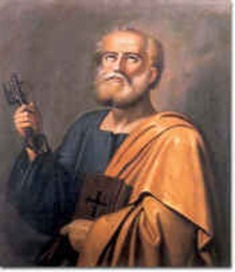
PeterI can hear Peter now: "Wait a minute, Lord. It's one thing to ask me to stay with this dirty tanner - but you can't seriously expect me to break kosher!" But God was serious - so serious, in fact, that soon eating some creepy crawlies would be the least of Peter's worries. When a Roman soldier and servants arrive in Joppa, Peter is shaken up enough that he obeys the Spirit's command: He accompanies them to Caesarea, to the home of Cornelius.

When Peter arrives at Cornelius' home - which I am sure was much nicer than Simon's place - his host greets him by falling to his knees in reverence. After getting him back on his feet, Peter reminds Cornelius that he normally would not even make this visit - Jews don't visit non-Jews; it just isn't done. But Peter knows God is behind this, even if he does not like it, and he obeyed. When Peter asks Cornelius why he wanted to speak with him, Cornelius shares about his encounter with the angel, and gives Peter perhaps the best invitation ever for evangelism: "...We are all here in the presence of God to listen to everything the Lord has commanded you to tell us."

The Dividing Wall Comes Down


Finally, Peter gets it. God is inviting Gentiles to become part of the people of God! Even after the startling vision that God sent to Peter earlier in the day, I doubt he was convinced; to accept an uncircumcised Roman as a member of God's household was still too much for Peter. But now, standing in the presence of this upright, God-fearing Gentile, God changes Peter's heart.
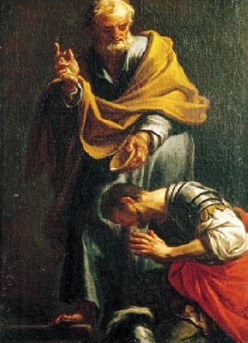
Baptism of CorneliusPeter preaches the good news of Jesus Christ to Cornelius and his household, and while he is still speaking the Holy Spirit descends on the gathered meeting. To Peter's astonishment, those present began to speak in tongues and praise God. Peter's world is turned upside down. No one can call unclean what God has made clean. The Centurion and his household - already baptized by the Holy Spirit - are baptized with water and become brothers and sisters in Christ with the Jewish Christians.

Humbled and United in Christ


The story of Cornelius demonstrates how the power of God can overcome those traditions in our society that wall us off from one another, hindering the flow of God's love and justice. This story is particularly powerful in how it shows the power of the Holy Spirit to humble all of us, regardless of on which side of the dividing wall we stand.

PeterActs 10 is just as much a story of the conversion of Peter as it is of Cornelius. Cornelius and his household undoubtedly underwent a great change as the Spirit descended and they became sons and daughters of God; this was a life-altering event that echoes through eternity. Nevertheless, the conversion of this Roman Centurion was an outgrowth of the faithful seeking and moral integrity that he demonstrated for many years before his encounter with the angel. Cornelius had gone as far as he knew how to go under the law, and God met him in his weakness and humility, drawing him near by the blood of Christ.

Peter's change was in many ways harder. While Cornelius was well-aware of his own separation from the God of Jacob, Peter could probably trace his ancestry back to the patriarchs. He had grown up following all the rules, secure in the knowledge of his special status as a Jew. In order to respond to the new thing that God had done in Jesus, Peter had to overcome his entire upbringing, which told him that the Jews were a nation apart, forever separate. He had to discover that Christ's grace is universal, available to all people, and uniting everyone in one love and life.

Cornelius the CenturionWhen Cornelius knelt before Peter, Peter knew that he was unworthy of such veneration. Cornelius made him so uncomfortable with his reverence that Peter was forced to acknowledge their spiritual equality: "Stand up, I am just a man myself." Cornelius, in his demonstration of faithfulness and Christ-like humility, opened the way for a reconciliation between Jew and Gentile. Peter was set apart by birth as an observant Jew, and he was personally chosen by Jesus himself - the rock upon which Christ would build his Church. Yet, none of this made him any better than an unclean Gentile who sought earnestly after God. Peter had to embrace that which the Holy Spirit blessed, though it toppled his whole worldview.

Cornelius and Peter


We at Capitol Hill Friends have been like both Cornelius and Peter. All of us at some time or another have felt beyond the scope of God's love; we have felt unable measure up to the holy, God-fearing lives we feel called to. At the same time, each of us has had moments when we judged others, deciding for ourselves that another person or group was beyond our concern, outside of our responsibility and love. And yet, the Holy Spirit can overcome all of our feelings of unworthiness and judgment of others. The rule-defying love of Jesus humbles and embraces us all as we come to acknowledge his lordship in our life as a community. Through his living presence, we become one people, despite all our differences.

The road that we are called to walk together will not be easy. When we are in the condition of Cornelius, we will be called to change as we come out of the law that condemns us and into the beautiful grace and forgiveness of Jesus Christ. In those times that we find ourselves in the condition of Peter, we will be prompted by the Spirit to let go of our spiritual pride and selfish hording of God's love. Jesus stands at the door and knocks: He longs to embrace us, if only we will humble ourselves and open the door. I pray that we may be like Cornelius, who worshiped God despite his profound sense of unworthiness and separation. Lord, let us be like Peter, who allowed his spiritual pride to be nailed to the cross of Christ. Help us to live into a radical life of love and freedom in Christ's Kingdom, though we know it will turn our lives upside down.